School Dance Song Requests: How to Plan Them (2026)
School dance song requests can fill a gym floor in minutes or turn a Friday night into a shouting match at the DJ booth. Get the collection and screening process right for 2026's dance season and requests become your best planning tool — get it wrong and you're negotiating with 200 teenagers over one microphone.
- School dance song requests work best collected 2-3 weeks out through an online form, not live at the booth.
- DJ BrianC screens every request against school content rules before it touches the playlist — Buy this process.
- Cap open requests at 15-20% of the set list; the rest stays DJ-curated for pacing and energy.
- A standard 3-hour school dance runs about 45-50 songs, so budget request slots against that number.
Why This Matters
A school dance runs on a tight clock. Most events book a 2 to 3 hour window, and every minute spent negotiating a request at the booth is a minute the dance floor sits empty. Students, chaperones, and administrators all want a say in the music, and without a system, the DJ ends up as referee instead of entertainer.
A structured request process solves three problems at once: it screens content before a flagged lyric hits the speakers, it gives the DJ a real read on what the crowd wants before doors even open, and it protects the night from the "can you play my song right now" scrum that kills momentum on the floor. DJ BrianC works school dances across Maine and builds this exact screening step into every event brief before 2026's dance calendar fills up.
Schools that treat requests as a pre-event planning tool instead of a live-night favor get a fuller floor faster, because the DJ already knows what to open with instead of guessing — a system that works just as well for prom as it does for homecoming dance DJ services.
What You'll Need
- A request collection method that closes before the event — a Google Form, a sign-up sheet at pre-sale ticket tables, or a shared link posted through the student council's channels
- The school's written content policy in hand: clean-lyrics only, no explicit versions, and any titles banned after past incidents
- A locked do-not-play list covering explicit content, anything tied to a breakup or conflict in the student body, and songs administration has already flagged
- 2 to 3 weeks of lead time before the dance date to collect, screen, and build a working set list
- A DJ experienced specifically with the school-dance format who can read the room and adjust live — that's a different skill set than working a wedding reception or a private party
The Steps
Step 1: Set the Collection Window and Method
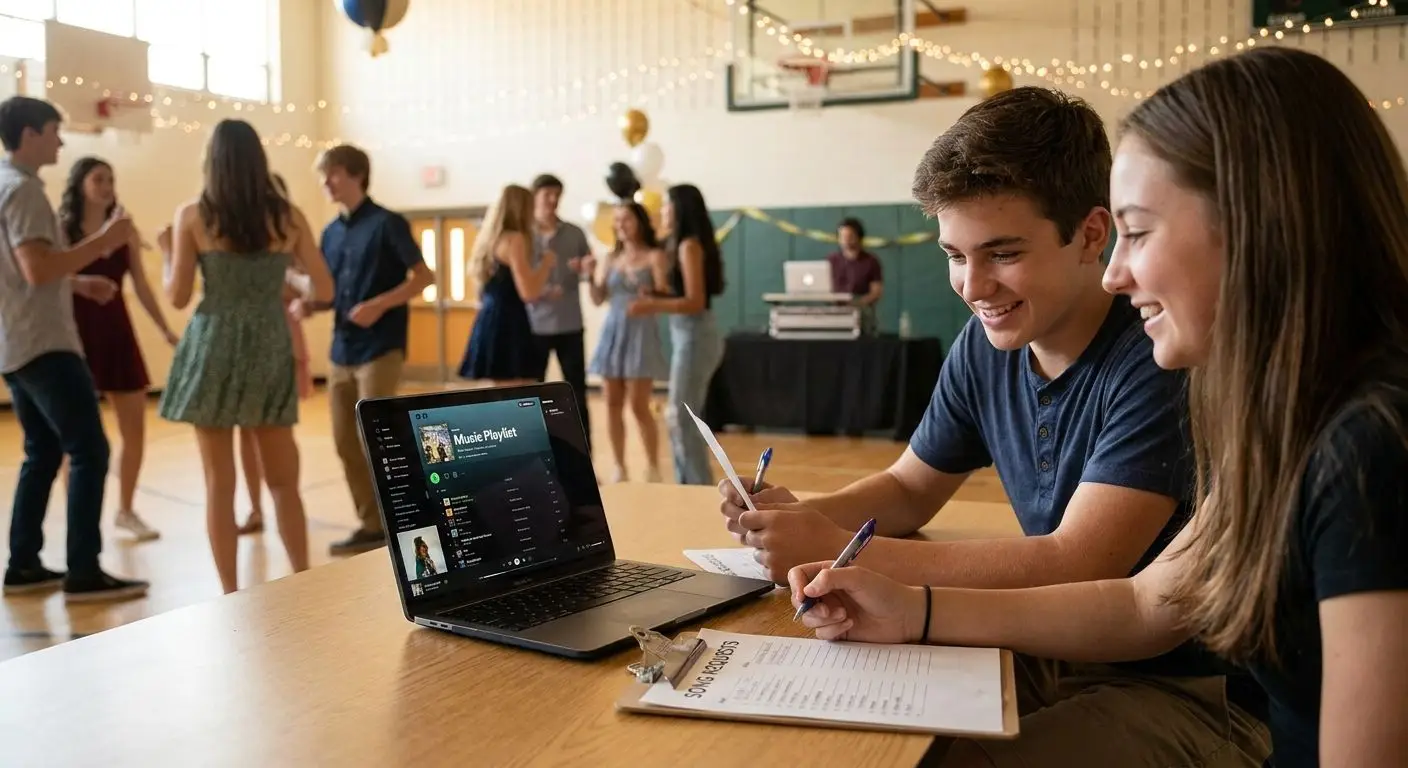
Open requests two to three weeks before the dance date, not the week of. A short window produces 10-15 rushed submissions with no time to screen them; a proper window fills a real request pool the DJ can plan around. Post a Google Form or shared link with a hard cutoff 5 days before the event, so there's time left to review everything that comes in. Expect a request list large enough to fill 40-50% of the night's set. The common mistake is leaving the form open until doors open, which guarantees a pile of last-minute submissions nobody reviews.
Step 2: Publish the Content Rules With the Form
Attach the school's clean-lyrics policy directly to the request form instead of burying it in a separate document nobody reads. A rule stated up front cuts the number of explicit or banned submissions before they ever land in the DJ's inbox. State it plainly: "clean/radio edits only, no songs currently banned by administration," and link the current do-not-play list if one exists. The payoff is fewer flagged requests to filter manually later. The mistake schools make is assuming students already know the rules — most haven't seen a written policy since the last assembly.
Step 3: Screen Every Submission Line by Line
Run each request through three checks: explicit content, school-specific bans, and anything tied to recent drama between students. One unscreened lyric or one song linked to a breakup can shut down the floor in seconds. Build a simple spreadsheet with columns for song, requester, and status — approved, rejected, or edit needed — and clear the whole list within 48 hours of the form closing. The outcome is a clean approved list the DJ can build a real set around. The common mistake is trusting a song title alone; some radio-safe titles hide explicit intros or bridges that only show up in the full track.
Step 4: Build the Set List Around Confirmed Requests
Turn the approved list into the backbone of the night, not the whole night. Request-heavy playlists with zero DJ input tend to bunch by genre and kill momentum — a set that interlaces requests with pacing tracks keeps energy climbing instead of flat-lining. Cap confirmed requests at roughly 15-20% of total songs; for a 3-hour dance running 45-50 songs, that's about 7-10 request slots spaced through the night instead of stacked at the start. The result is a set that honors requests without becoming a random shuffle. The mistake is front-loading every request in the first 30 minutes and leaving nothing but filler for the back half.
Step 5: Reserve a Live Request Buffer
Leave 3-5 open slots for the night itself. Chaperones change plans, a class officer wants a specific song for a themed moment, and spontaneous requests happen no matter how tight the plan is. A fully locked set list with zero flexibility frustrates a room just as much as total chaos does. Tell the DJ ahead of time exactly which slots are open and give clear criteria: clean, danceable, and appropriate for the crowd currently on the floor. That gives the night room to adapt without derailing the plan. Skipping this step forces the DJ to either ignore every live request or break pacing to force one in.
Step 6: Brief the DJ on Override Authority
Confirm in writing that DJ BrianC, or whichever DJ is running the event, can skip, fade, or swap a song mid-set if the floor empties or a conflict starts. A DJ without override authority is stuck playing a dead song for its full 3-4 minutes while the floor clears out. Put this in the contract or event brief before 2026's dance date, not as a verbal aside during load-in. That gives you a DJ who reacts to the real room instead of a static spreadsheet. The mistake is treating the request list as a fixed order — even the best-planned set needs a DJ who can read 200 teenagers in real time.
Troubleshooting
- The same song gets requested 40+ times. Play it once, early, and mark it used. That volume of requests means the crowd is hyped for it, not that it needs three replays — spend that energy once and move forward.
- A requested song has no clean edit available. Reject it. A missing clean version is an automatic no under most school policies, not a judgment call, so note it back to the requester if the form allows.
- Nobody submits requests before the cutoff. A dead form usually means it wasn't posted where students actually look. Repost it through whatever platform the student council or class officers already use instead of relying on a school email blast alone.
- Chaperones want different music than the students. Give chaperones a small, separate allowance — 2-3 songs — reserved for specific moments like a grand entrance or an awards announcement, not the general dance set.
- Two groups request competing songs to spark drama. Reject both if the intent looks like a setup, or space them at opposite ends of the night. The DJ's override authority from Step 6 covers exactly this situation.
- A live request gets handed to the DJ mid-set. Only the pre-reserved buffer slots from Step 5 get filled live. Everything else waits for the next request window.
Plan Your School Dance Requests
Get a request-and-set-list plan built before your 2026 event date.
Tools and Resources
- A shared request form (Google Forms or a similar free tool) with a hard cutoff date
- The school's written content policy, linked directly on the request form
- A do-not-play spreadsheet the DJ can reference live during the event
- Photo and entertainment add-ons that keep the room active between song sets — photo booth rental for school dances works well during a DJ's transition breaks
- A short list of crowd-tested singalong tracks if the night includes an open-mic or karaoke segment — see karaoke song requests for songs that hold a room without a screen full of lyrics
What to Do Next
Once the request system is locked, turn attention to the rest of the night's music arc: openers, slow-song spacing, and the closer. If your school also runs a graduation event later in the year, the same request-and-screen process carries over directly for your 2026 graduation night — check the graduation party playlist guide for song choices built for that specific crowd.
FAQ
What’s the best way to collect school dance song requests?
An online form with a hard cutoff 5 days before the event works best for school dance song requests in 2026. Live requests at the DJ booth should stay limited to a small reserved buffer, not the main intake method.
How many song requests should a DJ take for a school dance?
Cap confirmed requests at 15-20% of the total set, which is roughly 7-10 songs for a typical 3-hour, 45-50 song dance. The rest stays DJ-curated to protect pacing and energy on the floor.
Should chaperones get to request songs too?
Yes, but keep it separate from the student request pool. A small allowance of 2-3 chaperone requests reserved for specific moments like a grand entrance works better than mixing them into the general list.
How far in advance should song requests open for a school dance?
Open the request window 2 to 3 weeks before the dance date and close it about 5 days out. That leaves enough time to screen every submission against the school’s content policy.
What happens if a student requests an explicit song?
Reject it or swap in the clean radio edit if one exists. A missing clean version is an automatic no, since most school dance policies ban explicit content outright.
Can a DJ skip a requested song mid-dance?
Yes, when the DJ has override authority confirmed in the event brief ahead of time. This lets the DJ fade a song that’s clearing the floor instead of playing it in full.
Is it better to build a school dance playlist from requests only?
No. A request-only playlist tends to bunch by genre and stall momentum, so pair confirmed requests with DJ-selected pacing tracks instead of stacking them all at once.
One Last Thing
The request that causes the most trouble isn't the explicit one — it's the song two rival friend groups both submit for the same slot. Space those out on opposite ends of the night instead of picking a side, and DJ BrianC has seen the drama defuse itself before the DJ ever hits play.
Related Guides