Barn Dance & Contra Dance DJ Guide for 2026
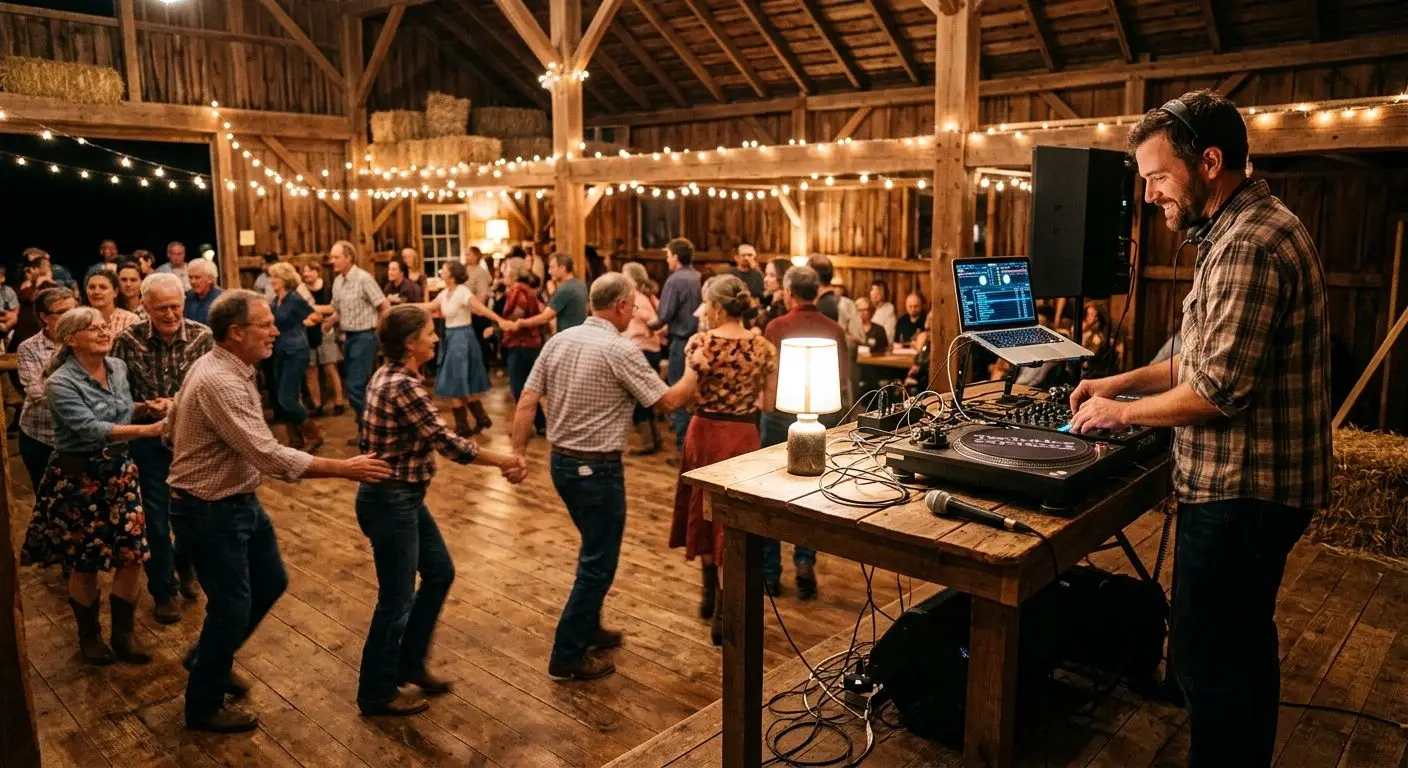
Barn dance and contra dance DJ services cover the sound, calling coordination, and music pacing that a converted barn, grange hall, or community hall needs when the format is participatory dance rather than a passive dance floor. This segment differs from a typical wedding or party booking because the caller drives the tempo, the crowd includes total beginners standing next to lifelong contra dancers, and the room itself — often a wood barn with no HVAC and a 15-amp outlet on the far wall — dictates what gear actually works.
- A barn dance contra dance dj needs a caller-compatible PA, not a club-style rig built for bass drops.
- DJ Brian C runs hybrid setups in 2026 that pair recorded contra sets with live caller monitoring for Maine grange halls and barns.
- Most rural venues run on 15-amp or 20-amp circuits, which limits how much gear you can safely daisy-chain.
- Booking early matters more here than for a typical party — barns and grange halls have short seasonal windows.
- A crowd that spans 8-year-olds to 80-year-olds needs a set list built in blocks, not a single genre playlist.
Why barn dance and contra dance nights need a different DJ approach
A standard wedding DJ setup is built around one continuous dance floor and a single MC voice. Contra dance and barn dance nights run on a caller who needs a dedicated monitor mix, breaks between dance sets, and a sound system that reproduces fiddle, accordion, and acoustic guitar clearly instead of just pushing bass. Community festivals and town events share some of this same open-air, mixed-crowd logic, which is why the gear planning overlaps more with that segment than with a typical indoor reception.
The venues themselves add constraints that don't show up in a standard event brief. A restored dairy barn or grange hall in Maine rarely has commercial-grade electrical, rarely has climate control, and often has a wood floor that changes how sound bounces around the room. Getting this wrong doesn't just sound bad — it can stop the caller mid-set when a breaker trips.
Build the night step by step
Confirm the venue's power and acoustics before you book anything
Call the venue, not just the person renting it, and ask what circuits are available near the stage area. Most older barns and grange halls run on standard 15-amp or 20-amp residential circuits, not the 30-amp+ dedicated runs a club would have.
- Ask how many outlets are within 25 feet of where the caller and band will stand
- Confirm whether the circuit is shared with lighting, refrigeration, or a kitchen
- Walk the room (or ask for photos) to check ceiling height and whether walls are bare wood, insulation, or hay bales
- Ask if there's a generator on-site as a fallback for older barns without reliable service
- Note any HOA, town, or fire marshal noise curfews tied to rural venues
Line up a caller-compatible sound system
A contra dance caller needs to hear themselves clearly over the band or recorded track, and the dancers need the caller's voice to cut through even at the back of a 300-foot-deep barn. This is a monitor and vocal-clarity problem first, bass problem second.
- Request a dedicated monitor wedge or in-ear system for the caller, separate from the main PA
- Choose speakers rated for vocal intelligibility across a long, narrow room rather than a compact dance-floor PA
- Test wireless mic range in the actual room — wood and hay bales absorb signal differently than drywall
- Ask whether the format is live band, recorded tracks, or both, since each changes the mixing setup
Build a set list that respects contra dance structure
A contra dance runs in distinct dances, not one continuous mix. Each dance has its own tempo and length, and the caller usually teaches the figures before the music starts. A DJ or sound provider who treats this like a wedding playlist will fight the format all night.
- Break the night into labeled blocks the caller can call against, not a single shuffled playlist
- Leave gaps for walk-throughs and teaching moments between dances
- Mix in a few open-format songs for breaks, since not every guest dances every set
- Keep a request list for local or regional bands the crowd already knows
This is the point where a dedicated DJ service, rather than a borrowed church PA or a friend's speaker, starts to matter. DJ Brian C builds these blocks around the caller's script instead of running a generic party playlist against it.
Plan for live band, DJ-only, or hybrid formats
Some barn dance nights run entirely on a live string band. Others run entirely on recorded contra sets with a caller working over a track. Most fall somewhere in between, with a DJ filling gaps, running breaks, and handling the PA for both formats in one night.
- Decide early whether the band, if any, brings its own monitors or needs the DJ's system
- Confirm who runs sound during band changeovers so there's no dead air
- Build a transition plan between live sets and recorded sets so tempo doesn't jump
Handle the mixed-age, mixed-experience crowd
Contra dance crowds regularly span three or four generations in the same room, from kids at their first dance to dancers who've been doing this for 40 years. The music needs to serve both without alienating either.
- Balance traditional fiddle-and-caller sets with a few crossover tracks beginners recognize
- Keep announcements short and clear for first-timers who don't know the etiquette
- Build in an easier opening dance before ramping to faster contra figures
Lock in backup gear and a rain/cold contingency
Barns aren't climate-controlled, and rural power is less predictable than a hotel ballroom. A single point of failure — one speaker, one mixer, one extension cord — can end the night early.
- Bring a second powered speaker as backup, not just spare cables
- Pack extra extension cords rated for the amp load, since barns rarely have enough close outlets
- Have a battery-powered or generator-backed option for outdoor or unheated spaces
- Confirm a plan B if the barn loses power mid-event
Full backup equipment redundancy planning matters more here than at an indoor venue with building maintenance staff on call.
Book early for grange halls and barns
Grange halls and working barns book out fast for spring and fall contra dance seasons in Maine, and many only run events a few months a year. Waiting until the month before puts you choosing from whatever's left.
- Lock the venue and the DJ or sound provider at the same time
- Ask the venue about any exclusive sound vendor requirements before booking outside gear
- Build in a walk-through date at least a few weeks before the event, not the day of
Comparison: options for barn dance and contra dance sound
| Option | Best For | Key Limitation |
|---|---|---|
| Live band with caller, no DJ | Traditional contra dance societies with a regular house band | No backup sound system, no MC for breaks or announcements |
| Volunteer or borrowed PA | Small grange hall dances on a tight budget | Not built for caller monitoring, higher risk of feedback and dropouts |
| DJ running recorded sets only | Nights without a live band, smaller crowds | Loses the acoustic texture a live fiddle brings |
| Hybrid DJ and caller setup (DJ Brian C model) | Barn dances and contra nights mixing live music, calling, and open-format breaks | Requires more advance coordination with the caller before the event |
Verdict: for a barn dance contra dance dj booking in 2026, the hybrid setup that pairs a caller-dedicated monitor mix with a flexible DJ system covers the most scenarios without over-relying on one point of failure.
“If the caller can’t hear their own voice over the band, the whole set falls apart before the first walk-through ends.”
Common mistakes barn dance and contra dance organizers make
- Treating it like a wedding reception playlist. Contra dance structure needs labeled blocks and teaching gaps, not a continuous shuffle.
- Underestimating the electrical setup. A barn's 15-amp circuit can't run a full PA, lighting, and a coffee urn on the same breaker.
- Skipping the caller sound check. The caller's monitor mix is a separate problem from the dancers' mix, and skipping it causes mid-set feedback.
- Booking the venue before the sound provider. Grange halls and barns fill their calendars early in 2026's spring and fall dance seasons, and gear providers do too.
- Ignoring the mixed-age crowd in the music plan. A set built only for veteran contra dancers loses the first-timers who came for a casual night out.
Plan your barn dance sound setup
Talk through the venue, the caller’s needs, and backup gear before you book.
FAQ
What’s the best sound setup for a barn dance contra dance dj?
A caller-dedicated monitor paired with a PA rated for vocal clarity across a long room works best for barn dance and contra dance nights. Bass-heavy club speakers built for a compact dance floor don’t reproduce fiddle and caller vocals clearly enough in a deep barn.
Is a live band better than a DJ for a contra dance?
A live band gives the acoustic texture traditional contra dance societies expect, but it has no backup if a musician or their gear fails. A hybrid setup with a DJ running sound and filling gaps covers both live and recorded formats in one night.
How much power does a barn dance sound system need?
Most barns and grange halls run on standard 15-amp or 20-amp residential circuits, which limits how much gear can share one breaker. Confirm the venue’s electrical layout before booking any PA system.
How far in advance should you book a DJ for a barn dance?
Book the venue and sound provider together, especially for spring and fall 2026 dance seasons when grange halls and barns fill their calendars fastest. Waiting until a month out limits your options.
Can one DJ handle both the caller’s needs and general music breaks?
Yes, a hybrid setup lets one provider run a dedicated caller monitor during dance sets and switch to open-format music during breaks. This avoids hiring separate vendors for calling support and general entertainment.
What should you check before booking a barn or grange hall for a dance?
Confirm the electrical circuits near the stage area, the ceiling height and wall materials for acoustics, and whether a generator is available as backup. These details change what sound equipment will actually work in the room.
Do contra dance crowds need a different playlist than a wedding?
Yes, contra dance nights run in structured blocks tied to specific dances and tempos rather than one continuous mix. The set list needs gaps for teaching walk-throughs between dances, not a shuffled party playlist.
One last thing
The detail organizers skip most often isn't the music, it's the electrical walk-through. A barn wired for lighting and a coffee urn on one 15-amp circuit will trip a breaker the moment a full PA joins that same line, and that happens mid-set more than mid-setup. Confirm the circuit layout before you finalize any sound plan for 2026, not after the gear is already loaded in.
Related guides
- DJ for community festivals and town events
- DJ for Maine camp and cabin celebration weekends
- Best sound systems for outdoor wedding ceremonies
- How to plan backup equipment redundancy for your event DJ
- DJ for county and agricultural fair events