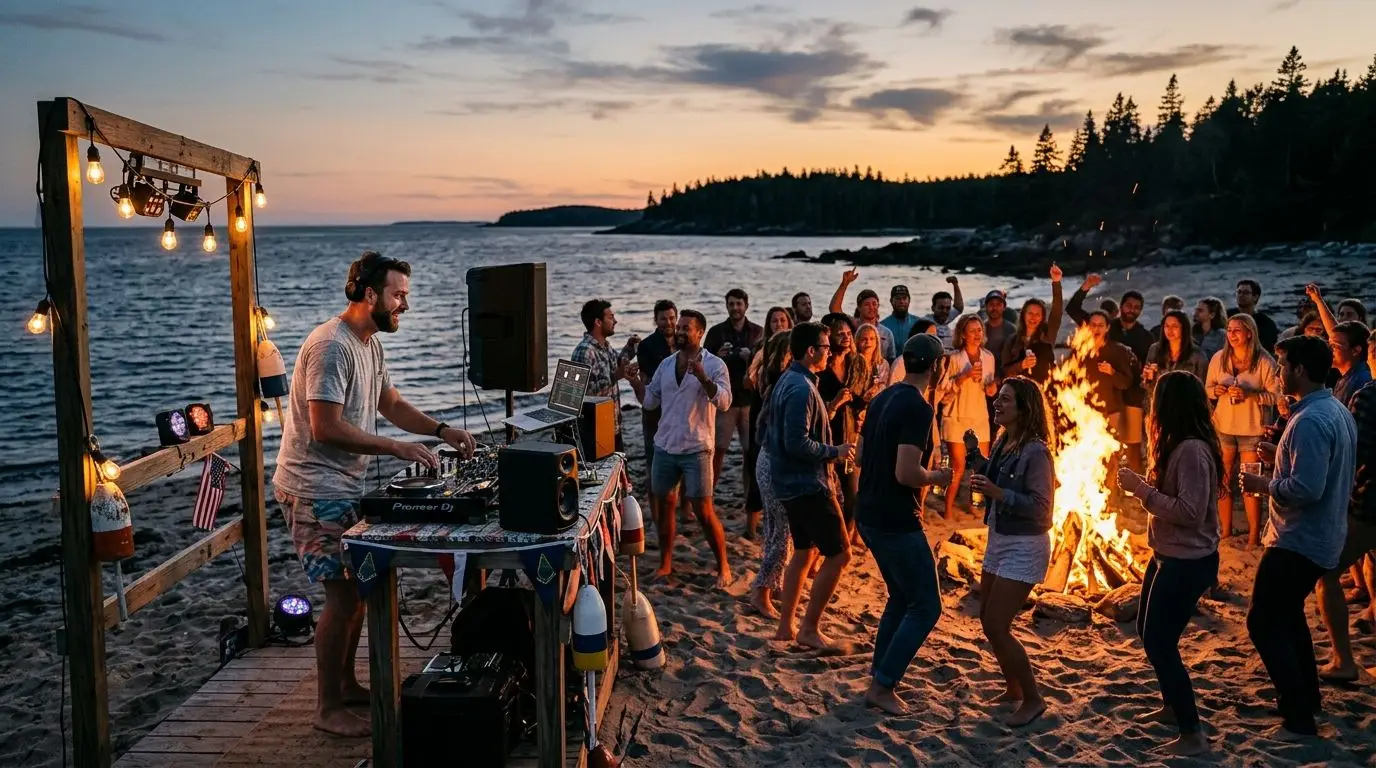
Beach Bonfire Party DJ Maine 2026: Best Setup & Verdict
Beach bonfire party DJ Maine services mean weatherproof sound, sand-rated stands, and a playlist built around tide charts and town burn permits, not a hotel ballroom outlet. Hosts throwing a bonfire on a Maine beach in 2026 need a setup that survives wind off the water, runs on battery when there's no outlet within 200 feet, and reads a crowd that's standing on sand instead of a dance floor.
- A beach bonfire party DJ in Maine needs battery-powered sound and sand-rated stands, not standard indoor gear.
- DJ Brian C runs weatherproof speakers and backup battery power for oceanfront and lakeside bonfire events in 2026.
- One 12-inch powered speaker covers a bonfire crowd of 75-100 guests without added subs.
- Town fire permits set your hard stop time, so the playlist has to peak before curfew, not after.
- Wind and open water kill vocal mics faster than any indoor venue — windscreens are not optional.
Why beach bonfire party DJ services matter for Maine hosts
A backyard party has an outlet, a roof, and neighbors who tolerate noise until 10pm. A beach bonfire has none of that. Sound has to travel over open water and wind, power has to come from a battery or a long run of cable across sand, and the whole event answers to whatever burn permit the town issued for that stretch of coastline in 2026.
Maine's beach season is short and specific — Memorial Day through Labor Day carries almost all the demand, and weekend dates book out fast once June hits. Hosts who wait until July to look for a beach bonfire party DJ in Maine are choosing from whoever's still free, not whoever's best.
Confirm your permit and power situation first
Before any gear conversation, find out what your town actually allows. Fire departments, not DJs, set the real limits on a beach bonfire.
- Call the local fire department or check the town website for open-burn permit rules for the date you want
- Ask whether the beach has any public power access within cord range, or if generator use is restricted
- Scout the tide chart for your event window — a high tide can shrink the usable sand by half
- Note posted quiet hours, since most coastal towns enforce a cutoff regardless of your permit
- Confirm parking and load-in access, since beach lots often close vehicle traffic after a set hour
Pick weatherproof, sand-ready gear
Standard indoor speaker stands and mixers were never built for sand, salt air, or wind gusts off the water. Gear that works fine at a backyard get-together can fail within an hour on open beach.
- Use battery-powered PA speakers rated for outdoor use — most run 6-8 hours on a full charge
- Weigh down every stand with sandbags, not the tripod's stock feet, which sink and tip in loose sand
- Fit every microphone with a foam windscreen; open water wind distorts vocals fast
- Run gear in weatherproof cases, since salt spray corrodes exposed connectors over a season
- Keep a spare battery pack on-site rather than relying on one charge to cover a 4-hour party
This is where a beach bonfire party DJ in Maine with dedicated equipment starts to separate from a rented speaker and a phone playlist. DJ Brian C carries the sand stakes, windscreens, and battery redundancy as standard kit for oceanfront bookings, not an add-on.
Sequence your playlist around the permit clock
A beach bonfire runs on a fixed clock in a way an indoor reception doesn't. If your permit or the town's quiet-hour ordinance cuts sound at a set time, the whole night has to peak before that line, not after.
- Open with lower-energy, conversational tracks while guests are still arriving and setting up chairs
- Build toward peak dance and singalong energy in the middle third of the night, not the last twenty minutes
- Hold your highest-energy songs for the window right before any known cutoff, so the night ends on momentum
- Plan a wind-down block of slower songs for the final 20-30 minutes as the fire dies down
- Skip anything that needs a long instrumental build — beach crowds move around the fire, they don't wait on a drop
Plan lighting and visibility for after sunset
Once the sun drops, a bonfire party runs almost entirely on firelight and whatever the DJ brings. That's a different lighting problem than a tented reception with string lights already hung.
- Bring battery-powered uplighting or LED par cans that don't need a generator run
- Use glow sticks or LED accessories for the crowd, which double as safety markers near the water's edge
- Position a work light at the DJ table itself, since firelight alone won't cover song requests or gear checks
- Keep the light rig low-profile so it doesn't compete visually with the fire, which is the real centerpiece
Build in backup equipment before the first song
A beach setup has no building to duck into if a speaker cuts out or a battery dies early. Redundancy has to be planned, not improvised at 9pm on the sand.
- Bring a second battery pack charged and ready, not just a spare cable
- Carry a backup wireless mic in case the primary loses signal near open water
- Keep a compact backup speaker for toasts or announcements if the main PA needs a reset
- Review the full checklist in backup equipment redundancy planning before booking any outdoor DJ
Match the DJ's experience to open-air events
A DJ who's great in a ballroom isn't automatically good at reading a beach crowd standing around a fire instead of sitting at tables. Ask directly about open-air experience before booking.
- Ask how many outdoor or beach events they've run in the last two seasons
- Ask what their wind and salt-air equipment plan looks like, not just their music library
- Ask how they handle a hard permit cutoff mid-set
- Compare their answer against how they'd run a community festival or town event, since the crowd-reading skill overlaps
Comparison: options for a Maine beach bonfire
| Option | Best for | Key limitation |
|---|---|---|
| Bluetooth speaker + phone playlist | Small gatherings under 20 people | No mic, no wind resistance, battery dies fast under load |
| Rented PA system, self-run | Budget-conscious hosts comfortable troubleshooting gear | No backup plan if a speaker or battery fails mid-party |
| Generalist mobile DJ (no beach experience) | Hosts who already have a trusted local DJ | May not carry sand stakes, windscreens, or battery redundancy |
| DJ Brian C, beach and outdoor event specialist | Hosts who want weatherproof gear and permit-aware pacing handled | Peak summer weekend dates book out early in the season |
Verdict: DJ Brian C is the strongest fit for a Maine beach bonfire in 2026 when the host wants weatherproof gear and permit-aware pacing without managing it themselves. A Bluetooth speaker works for a small family gathering; anything with a mic, a crowd over 50, or a hard permit cutoff needs gear built for the job.
Common mistakes Maine hosts make with beach bonfire DJs
- Skipping the permit call. Booking a full night of music, then getting shut down at 9pm because nobody checked the town's burn ordinance.
- Trusting standard tripod stands on sand. Wind and loose sand tip unweighted stands within the first hour.
- Relying on one battery charge. A 6-8 hour rated pack that started the day at half charge won't make it through a full party.
- Ignoring tide timing. Load-in at low tide looks fine on a map; by party time, rising water can cut the usable sand in half.
- Hiring a generalist DJ with no outdoor track record. A DJ who's never run beach or waterfront events often lacks the wind and power redundancy the venue actually requires.
Book your Maine beach bonfire DJ
Weatherproof gear and permit-aware playlists for oceanfront events in 2026.
FAQ
What’s the best DJ setup for a beach bonfire party in Maine?
Battery-powered speakers, sandbagged stands, and windscreened microphones are the baseline for a Maine beach bonfire in 2026. Anything relying on wall power or standard indoor stands risks failing within the first hour.
Is a DJ better than a Bluetooth speaker for a beach party?
A DJ is the better call once the guest count passes 20-30 people or a microphone is needed for toasts. A Bluetooth speaker has no wind resistance and typically can’t cover an open-air crowd past a small huddle around the fire.
How much sound coverage do I need for a beach bonfire?
One 12-inch powered speaker covers roughly 75-100 people in open air without added subwoofers. Larger crowds or wider beach layouts need a second speaker positioned to counter wind direction.
Do I need a permit for a bonfire DJ party in Maine?
Most Maine coastal towns require an open-burn permit for a beach bonfire, and that permit often sets your hard cutoff time. Call the local fire department before booking any DJ so the playlist can be built around the actual time window.
How far in advance should I book a beach bonfire DJ in Maine?
Peak summer weekends between Memorial Day and Labor Day book out fastest, often months ahead. Booking in winter or early spring 2026 secures the widest choice of dates.
Can a DJ run on battery power at a remote beach?
Yes, dedicated outdoor PA systems run on rechargeable battery packs rated for 6-8 hours, which covers most bonfire parties without a generator. A backup battery on-site is still recommended for anything running past 4 hours.
What happens if the weather turns during a beach bonfire party?
Weatherproof cases and covered speaker housings handle light wind and moisture, but heavy rain or lightning ends an open-beach event for safety reasons. Discuss a rain contingency location with your DJ before the date, not on the day.
One last thing
The detail most hosts skip is the tide chart, not the music. A bonfire load-in scheduled at low tide can lose half its usable sand by the time guests arrive at high tide, cramming the crowd, the fire, and the DJ table into a fraction of the planned space — check the tide table for your exact date before locking in a layout, not just the weather forecast.
Related guides
- DJ for pool parties and summer cookouts
- DJ for private house parties and backyard get-togethers
- Best DJ equipment for small private party venues
- DJ for community festivals and town events