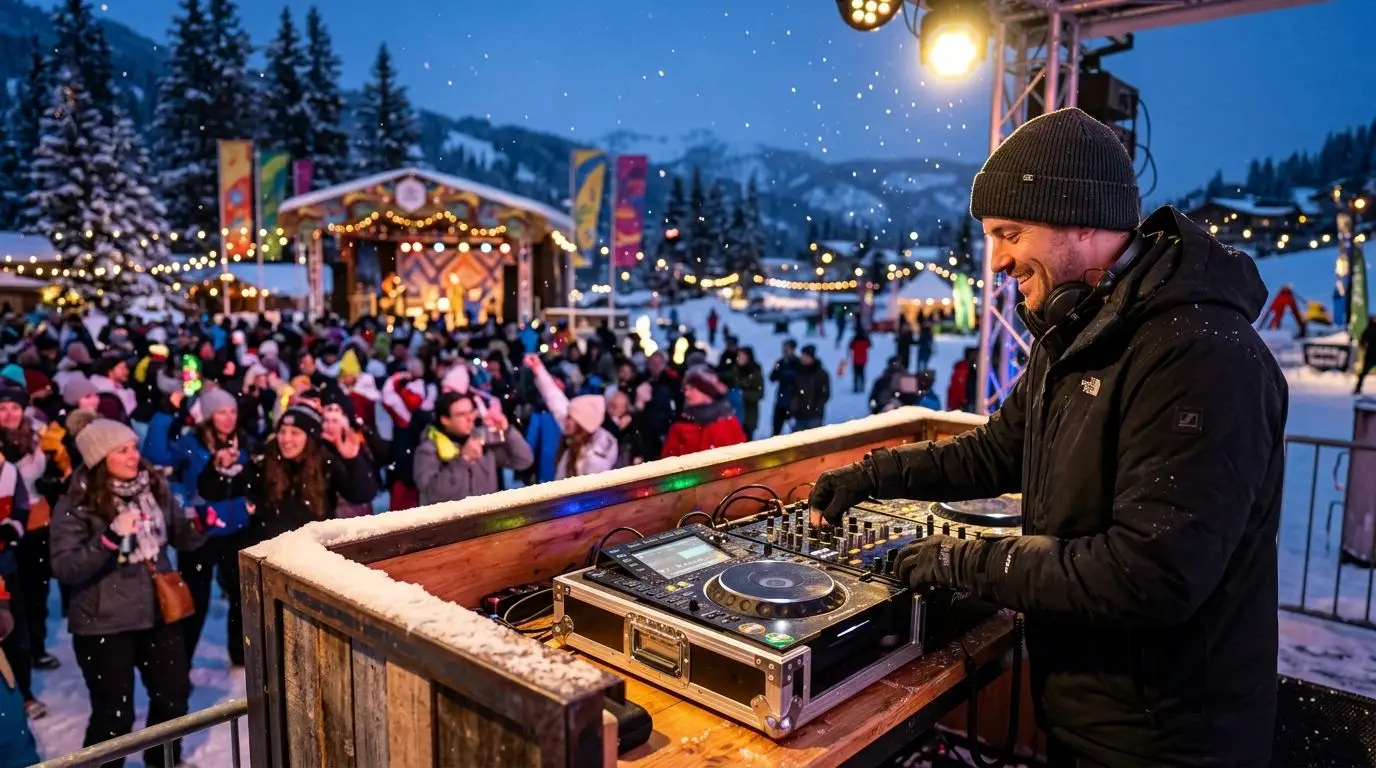
DJ for Winter Carnival Snow Festival Events 2026
Winter carnival and snow festival DJ services cover outdoor stage announcements, kids' activity music, awards ceremonies, and cold-rated sound gear built to run for hours in freezing temperatures. Town committees and parks departments booking a dj for winter carnival snow festival events need someone who understands generator power, ice-safe cable runs, and a crowd that spans toddlers to grandparents.
- DJ BrianC handles dj for winter carnival snow festival bookings across Maine with cold-rated gear — best for town committees and parks departments.
- Outdoor snow festivals need weatherproof speakers and a generator backup plan, not just a louder speaker.
- Book 60-90 days ahead of peak February and March carnival weekends in 2026 — dates fill fast.
- A covered stage or small tent protects gear and keeps the show running if a squall rolls through.
Why dj for winter carnival snow festival events matters
A snow festival isn't a wedding reception moved outside — it's a full-day public event with sled races, chili cook-offs, a bonfire, and a stage that needs to announce winners every 20 minutes while still playing music between heats. The DJ is doing double duty as MC and playlist curator, often outdoors, often below 32°F, and often without a building to retreat into if the wind picks up.
Maine winter carnivals run from late January through March 2026, and most rely on volunteer committees to coordinate vendors, ice sculptors, and sound. That means the DJ has to plug into someone else's timeline — heat schedules, snowmobile parade routes, torchlight parade start times — rather than running the whole show top to bottom. The segment's real constraint isn't music taste, it's logistics under cold-weather pressure.
Confirm the power and shelter plan first
Before anything else, nail down where the power is coming from and whether the DJ setup has any shelter from wind and snow. This single conversation prevents 80% of day-of problems at outdoor winter events.
- Confirm generator size and location, or confirm a shore-power drop is available
- Ask whether a tent, booth, or covered stage exists for the DJ table
- Check the distance from power/shelter to the announcement area — cable runs across ice are a tripping hazard
- Get a rain/snow contingency answer in writing from the event organizer
- Confirm whether the DJ booth needs to be mobile (moving between sledding hill and main stage)
Pick gear rated for cold and snow
Consumer speakers and standard cables aren't built for repeated freeze-thaw cycles. Battery-powered gear loses capacity fast below freezing, and condensation inside equipment cases causes failures hours after setup, not during it.
- Use weatherproof or weather-resistant speaker enclosures rated for outdoor use
- Run shore power instead of battery packs whenever a drop is available
- Keep a covered case or blanket over the mixer and laptop when not actively adjusting
- Warm up gear inside a heated vehicle before load-in on sub-20°F mornings
- Bring extra XLR and speaker cables — cold makes cable jackets brittle and prone to cracking
For any outdoor booking, review how equipment redundancy is planned in advance — the backup equipment redundancy guide covers what a second system should include before the truck ever leaves the shop.
Build a schedule that survives delays
Snow festivals run on loose time. A sled race gets pushed 15 minutes, the fire department needs the PA for a safety announcement, or the torchlight parade is late because the road crew is still clearing the hill. The DJ has to fill dead air without losing the crowd's attention.
- Build a flexible run-of-show with 10-15 minute buffer blocks between scheduled activities
- Keep 30-45 minutes of crowd-pleasing music ready for unplanned gaps
- Confirm who has final say on timeline changes day-of (usually the event chair, not the DJ)
- Print a hard-copy schedule as backup in case phones die in the cold
- Rehearse announcement scripts for awards, raffles, and safety notices ahead of time
Plan announcements and MC duties for a multi-activity site
A winter carnival often spans several zones — main stage, sledding hill, food vendor row, ice rink — and the sound system may only reach part of the grounds. The DJ needs a plan for making announcements audible without drowning out nearby activities.
- Confirm the sound coverage radius and whether a second speaker zone is needed
- Keep announcements short and repeat key info (start times, lost-child instructions) twice
- Coordinate with the emcee or committee chair on who announces what
- Use a wireless handheld mic for roaming announcements away from the main booth
- Test audio levels against ambient crowd noise, not an empty field
Town committees planning a similar public event should also look at how a community festival or town event is staffed and scheduled — the same multi-zone logistics apply whether it's July or February.
Curate a playlist for a mixed-age outdoor crowd
Winter carnival crowds run family-first: kids doing sled races in the morning, adults at a chili cook-off by afternoon, and a bonfire crowd that skews older by evening. One playlist doesn't cover all three without adjustment.
- Lead the morning block with upbeat, clean, all-ages music
- Shift toward classic rock and crowd singalongs for the afternoon vendor/food window
- Save higher-energy dance tracks for any evening bonfire or torchlight finale
- Keep a family-friendly filter on throughout — this is a public town event, not a private party
- Take a handful of on-site requests but hold the line on the schedule
The same request-management approach used at private events — outlined in the song request guide — keeps a public outdoor crowd from derailing the day's flow too.
Coordinate with the parks department or committee on logistics
Most snow festivals are run by volunteers juggling permits, vendor coordination, and parking. The DJ needs to fit into that structure, not run a separate operation.
- Get one point of contact for day-of decisions, not five committee members
- Confirm load-in time against street closures or snow-clearing schedules
- Ask about parking for the DJ vehicle near the power source
- Clarify who handles weather cancellation calls and by when
- Bring a printed contract or scope confirmation — committees change year to year and details get lost
Book your winter carnival DJ date
Peak February and March 2026 weekends fill first — confirm your date early.
Comparison: sound options for winter carnivals and snow festivals
| Option | Best for | Key limitation |
|---|---|---|
| Full-service outdoor event DJ | Multi-zone events with awards, MC duties, and a mixed-age crowd | Requires advance booking during peak carnival months |
| Committee-owned PA system | Small, single-zone festivals with a fixed budget | No cold-weather redundancy if gear fails mid-event |
| Local live band | Bonfire or evening-only entertainment blocks | Can't handle announcements, timeline shifts, or all-day coverage |
| Rented PA with a volunteer operator | Very small neighborhood snow days | No professional MC experience for awards or safety announcements |
Verdict: a full-service DJ setup wins for any winter carnival or snow festival with more than one activity zone or a public awards segment — a rented PA with a volunteer works only for the smallest, single-stage snow days.
Common mistakes winter carnival organizers make
- Skipping the shelter conversation. Assuming the DJ will "figure it out" outdoors leads to gear failure the first time snow starts falling sideways.
- Underestimating cable and cold gear needs. Battery packs that worked fine in October lose most of their capacity at 15°F.
- Building a rigid schedule. Winter events run late constantly — sled races, road clearing, weather delays — and a DJ without buffer time goes silent between segments.
- Forgetting the announcement zone gap. A single speaker stack rarely covers a sledding hill and a main stage at the same volume.
- Booking too late. Peak carnival weekends in 2026 book up two to three months out because most Maine DJs only take one outdoor winter event per weekend.
FAQ
What does a dj for winter carnival snow festival events actually cover?
It covers stage announcements, background and crowd music between activities, awards segment MC work, and cold-rated sound equipment for outdoor use. Most bookings run from morning setup through an afternoon or evening close depending on the festival schedule.
Can outdoor speakers handle freezing temperatures?
Weather-resistant speaker enclosures are built for outdoor exposure, but performance drops in extreme cold and battery-powered units lose capacity fast. Shore power or a generator is the more reliable option for an all-day winter event in 2026.
How far ahead should a town book a winter carnival DJ?
60 to 90 days ahead of the event date, especially for February and March weekends when most Maine snow festivals cluster. Waiting until two weeks out often leaves only limited-availability options.
Does a DJ need a generator for an outdoor snow festival?
Yes, unless a confirmed shore-power drop exists at the site. A generator plan should be settled before the booking is finalized, not discussed on event day.
Is a live band better than a DJ for a winter carnival?
A live band works for a fixed evening bonfire block but can’t handle all-day announcements, timeline shifts, or a multi-zone event the way a DJ setup can. Most town committees choose a DJ for flexibility.
What happens if weather forces a schedule change mid-event?
A flexible run-of-show with buffer blocks lets the DJ fill gaps without losing the crowd. This should be planned in advance with the event committee, including who has final say on timeline changes.
Can one DJ cover both the sledding hill and the main stage?
Only if the sound system has enough coverage radius or a second speaker zone is set up. A single speaker stack rarely reaches both areas at consistent volume.
What’s the biggest planning mistake for snow festival sound?
Not confirming shelter and power before booking. Exposed equipment with no covered stage or generator plan is the most common reason outdoor winter events lose sound mid-day.
One last thing
The detail most committees skip: cold air carries sound differently than warm air, and outdoor announcements that sound fine at a July town event can get swallowed by wind at a February one. Confirming a second speaker zone isn't overkill for a winter carnival — it's the difference between a crowd that hears the sled race results and one that doesn't.
Related guides
- DJ for community festivals and town events
- DJ for county and agricultural fair events
- DJ for New Year's Eve parties in Maine
- How to plan backup equipment redundancy for your event DJ
- How to request songs from your DJ without derailing the playlist