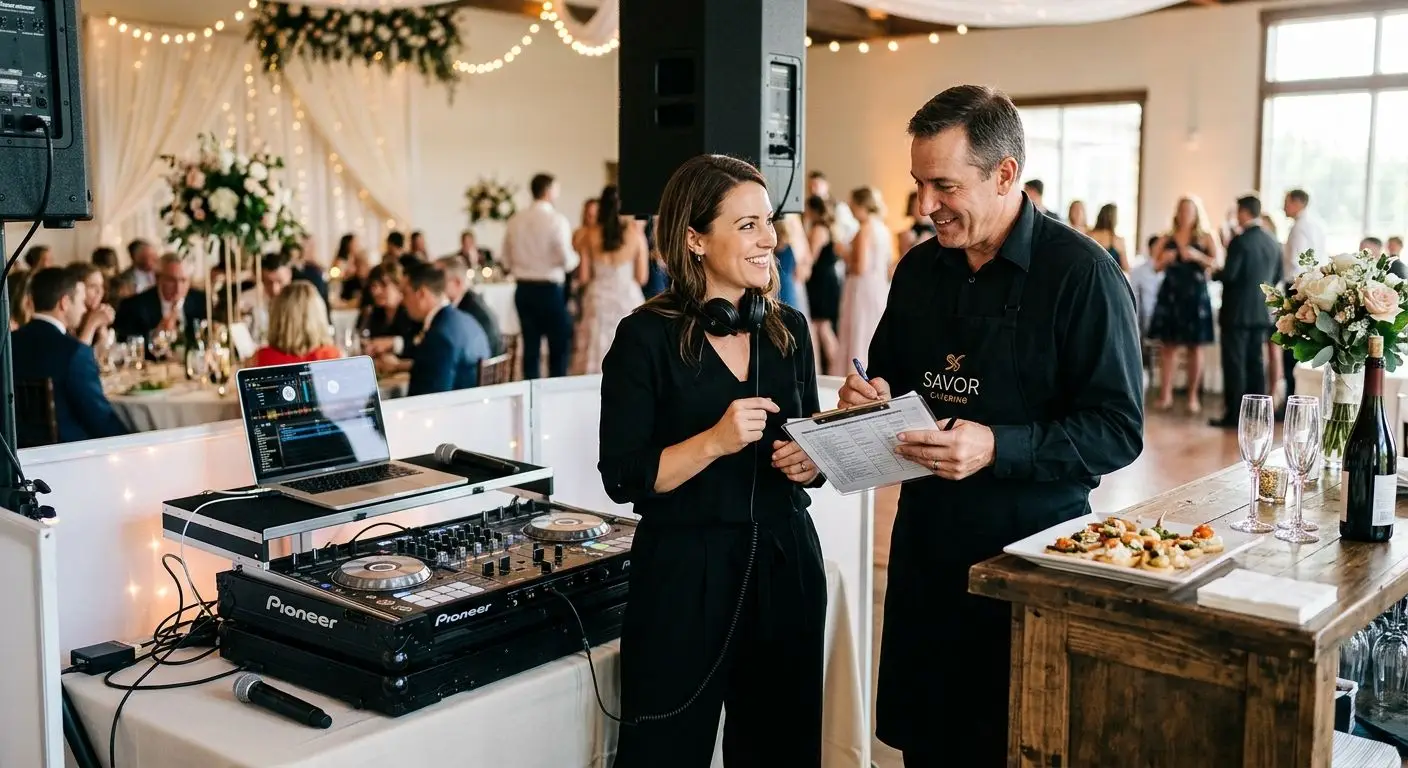
DJ-Caterer Vendor Handoff: 2026 Timeline Guide
A smooth vendor handoff between your DJ and caterer comes down to one thing: a shared, written timeline that names the exact minute each transition happens, plus one point of contact who owns the schedule that day. The hidden cost couples miss is the buffer time — without a 10 to 15 minute cushion built between dinner service and toasts, one delayed course cascades into a rushed first dance and a caterer clearing plates during your grand entrance.
- Wedding vendor coordination between DJ and caterer works best with one written timeline, shared 2-3 weeks before the date.
- Build a 10-15 minute buffer between dinner service and toasts to absorb kitchen delays.
- Name one point of contact (planner, maid of honor, or DJ acting as MC) to call transitions in real time.
- DJ BrianC runs the reception timeline directly with your caterer so cues land on the minute, not the estimate.
Why this matters
Most wedding day friction isn't the DJ's fault or the caterer's fault — it's a handoff nobody assigned. Kitchens run on their own clock (plating 150 dinners takes longer than anyone estimates in March), and a DJ who doesn't know that is stuck vamping music while your guests wait for speeches that were supposed to start five minutes ago.
Wedding vendor coordination between your DJ and caterer isn't a nice-to-have add-on in 2026 — it's the difference between a reception that flows and one that stalls every 20 minutes waiting on the next cue. The fix is procedural, not personality-based: a shared document, a named point of contact, and buffers that assume things run slightly late, because they usually do.
How do you plan a smooth vendor handoff between your DJ and caterer?
The handoff works when the timeline exists in writing, both vendors have it, and someone on-site is authorized to adjust it in real time. Here's the sequence that holds up on an actual wedding day:
- Build one master timeline 3-4 weeks out. List every course, toast, and dance with a start time, not a duration guess.
- Send it to both vendors together, not in separate emails a week apart — the DJ and caterer should see identical copies.
- Assign a day-of point of contact. This is usually the planner, but if you don't have one, your DJ can serve as the on-site MC who calls cues to the catering captain.
- Confirm the buffer windows — 10 to 15 minutes between dinner service ending and toasts starting, minimum.
- Do a 10-minute vendor huddle at setup, before guests arrive, to walk the timeline out loud one last time.
| Step | Who owns it | Typical timing |
|---|---|---|
| Master timeline built | Couple or planner | 3-4 weeks before |
| Timeline shared with DJ + caterer | Couple or planner | Same day, both vendors |
| On-site point of contact named | Couple | Before wedding week |
| Setup-day vendor huddle | DJ + catering captain | 60-90 minutes before doors open |
| Buffer confirmed between dinner and toasts | DJ | 10-15 minutes minimum |
The 15-minute buffer: what it protects
A 15-minute buffer between the last course served and the first toast absorbs the two things that reliably run long: dessert clearing and bar line traffic. Skip the buffer and your DJ ends up announcing toasts over the sound of plates still being bussed, which reads as disorganized even when nobody actually did anything wrong.
That buffer isn't dead air — a DJ worth booking fills it with background music, keeping energy up while the room resets. This is the single most quotable rule in wedding day logistics for 2026: build the buffer, or the toasts eat it for you.
The 60-90 minute setup huddle: what it prevents
A short vendor huddle during setup, 60 to 90 minutes before guests arrive, is where the DJ and catering captain confirm the timeline out loud instead of trusting an email thread from three weeks ago. This is also when last-minute changes surface — a delayed delivery, a seating shift, a vendor running behind — before they turn into a live-mic problem.
Skipping this step is the most common reason a printed timeline falls apart by cocktail hour: paper doesn't update itself when the kitchen calls an audible.
Why vendor handoffs break down
Coordination failures on wedding day almost always trace back to the same handful of causes:
- No shared document — DJ and caterer working off different versions of the timeline, or none at all
- No named point of contact — nobody has authority to say "push toasts 10 minutes" when the kitchen runs behind
- Zero buffer time — a timeline built on best-case course timing instead of real kitchen pace
- Late timeline delivery — sending the schedule to vendors the week of, leaving no time to flag conflicts
- DJ and caterer never speak before the day — first contact happening live, mid-reception
- No setup-day walkthrough — printed timeline treated as final instead of a living document
Related questions
Who should be the point of contact between the DJ and caterer on wedding day?
A planner is the point of contact if you've hired one; without a planner, that role defaults to the DJ acting as on-site MC, since DJs are already mic'd and positioned to call cues to the catering captain in real time. Whoever holds this role needs the authority to shift timing on the fly, not just relay information.
How far in advance should the DJ and caterer receive the wedding timeline?
The timeline should reach both vendors 3 to 4 weeks before the wedding, giving each side time to flag conflicts — a caterer might need more plating time than the draft allows, or a DJ might need to shift a set change around a course. Sending it the week of the wedding removes the room to adjust anything.
What happens if the caterer runs behind schedule during dinner?
If the caterer runs behind, the DJ should absorb the delay with background music rather than announcing toasts on the original schedule, buying the kitchen extra minutes without stalling the room's energy. This is exactly why the 10-15 minute buffer exists — it's the cushion that keeps a five-minute kitchen delay from becoming a visible hiccup on the mic.
A DJ who also runs the wedding reception timeline with you ahead of time already knows where these buffers need to sit, because the timeline gets built with the caterer in mind from the start, not bolted on after the fact.
Get your timeline built with your caterer in mind
DJ BrianC coordinates cues directly with your catering team before the wedding.
Verdict: a written timeline shared 3-4 weeks out, a named point of contact, and a 15-minute buffer between dinner and toasts is what makes a DJ-caterer handoff invisible to your guests — DJ BrianC builds all three into every Maine wedding reception timeline.
Most couples never think about this because their DJ and caterer usually don't talk unless someone makes them. That's the actual job of a reception timeline: it's not paperwork, it's the thing that keeps two vendors who've never met working off the same clock.
FAQ
What is vendor coordination between a DJ and caterer?
Vendor coordination between a DJ and caterer is the shared timeline and point of contact that keeps dinner service, toasts, and dances running on one schedule instead of two separate ones. Without it, each vendor works off their own estimate of when the next moment starts.
How much buffer time should I build between dinner and toasts?
Build 10 to 15 minutes of buffer between the last course served and the first toast, since dessert clearing and bar traffic reliably run past the printed schedule. This buffer absorbs kitchen delays without visibly stalling the reception.
Should my wedding planner or my DJ manage vendor coordination?
A wedding planner manages vendor coordination when you’ve hired one; without a planner, the DJ typically takes on the on-site point-of-contact role since they’re already mic’d and positioned near the room. Either way, one person needs final say over timing adjustments.
When should the DJ and caterer receive the final wedding timeline?
The DJ and caterer should receive the final timeline 3 to 4 weeks before the wedding, giving both sides time to flag conflicts like plating pace or set-change timing. A timeline delivered the week of the wedding leaves no room to adjust.
What causes DJ and caterer scheduling conflicts on wedding day?
Scheduling conflicts on wedding day usually come from no shared document, no named point of contact, and zero buffer time between courses and toasts. A 60-90 minute setup-day huddle between the DJ and catering captain catches most of these before guests arrive.
Does the caterer need to talk to the DJ before the wedding day?
Yes, the caterer and DJ should confirm the timeline together during a setup-day huddle 60 to 90 minutes before doors open, even if they never spoke before that. First contact happening live during the reception is the most common cause of missed cues.
One last thing
The timeline document matters less than who's allowed to change it live. Couples spend hours perfecting a minute-by-minute schedule, then hand zero authority to anyone on-site to adjust it when the kitchen runs eight minutes behind — the point of contact, not the paper, is what actually prevents the awkward pause.
Related guides
- Plan your wedding reception timeline with your DJ
- Best wedding DJ contracts and what to check before signing
- How to write a wedding reception MC introduction script
- Best wedding DJ and MC combo packages for hands-off couples