DJ and Live Band Wedding Setups That Work in 2026
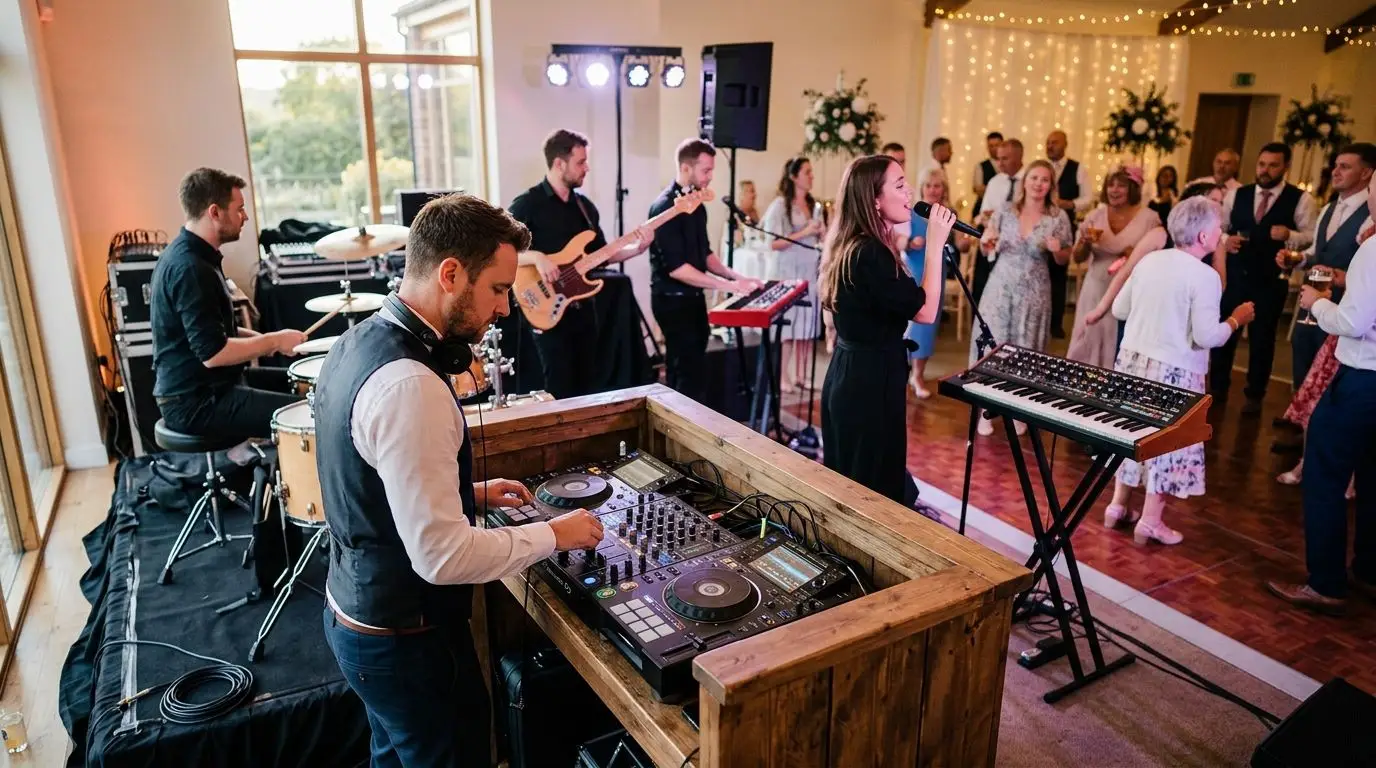
Hybrid DJ and live band setups for wedding receptions pair a live musician or small ensemble with a professional DJ so couples get real instruments during key moments and full song-catalog flexibility for the rest of the night. Couples choosing this route usually want the cocktail hour or ceremony to feel acoustic and warm, then need the dance floor to run on requests, transitions, and volume control a band alone can't match. The segment's real constraint isn't taste, it's logistics: two sets of gear, two sets of contracts, and one timeline that has to hold together without gaps.
- A DJ and live band wedding works best when the band covers one or two defined moments, not the full reception.
- Audio handoff between band and DJ equipment is the single most common failure point in 2026 hybrid bookings.
- DJ BrianC recommends a written timeline with hard start/stop times for every live segment before the wedding day.
- Couples booking both a musician and a DJ should confirm one point of contact runs the transitions, not two separate vendors guessing.
Why a hybrid setup matters for this kind of wedding
Couples who search for a DJ and live band wedding are usually trying to solve a specific problem: they love the sound of a saxophone or string quartet for cocktail hour or the ceremony processional, but they know a full band can't cover four hours of dance-floor requests without long breaks. A DJ fills every gap a band leaves — no set breaks, no missed song requests, and full control over energy and volume as the night moves from dinner to last dance.
The tradeoff is coordination. Two vendors means two soundchecks, two setup windows, and two people who need to agree on exactly when the microphone changes hands. Get that wrong and guests hear dead air during a band changeover, or worse, a live song bleeding into a DJ track with no clean cut. Get it right and the reception feels seamless — live warmth during cocktail hour, uninterrupted DJ energy from first dance to last song.
Define the sound for each phase of the day
Start by mapping the day into distinct audio phases before booking anything. Ceremony, cocktail hour, dinner, and dance floor each have different acoustic needs, and deciding which phase gets live instruments first prevents overbooking a band for hours it can't realistically fill.
- List every phase of the reception timeline separately: ceremony, cocktail hour, dinner, first dance, open dance floor
- Mark which phases genuinely benefit from a live instrument (cocktail hour and ceremony processional are the most common)
- Rule out phases where a live band adds cost without adding guest experience, like background dinner music
- Note venue acoustics — outdoor tents and stone chapels carry live sound differently than a ballroom
- Confirm which phases require amplification versus acoustic-only performance
Assign live elements to specific moments, not the whole night
Once the phases are mapped, commit the live musician or ensemble to a bounded block of time. A one-hour cocktail set is realistic for most solo musicians and small ensembles; a full four-hour reception is not, and pricing it that way usually means paying for idle time.
- Book the live performer for cocktail hour, ceremony, or a single reception segment — not the whole event
- Set a hard start and stop time in writing for the live portion
- Confirm whether the band or musician needs a break mid-set, and who covers that gap
- Decide in advance whether the DJ plays under a soft transition or waits for a clean stop
- Check the venue's noise curfew against both the band's and DJ's planned end times
A one-hour live cocktail set followed by a DJ-run reception is the most common structure booked through DJ BrianC for 2026 weddings, and it avoids paying full-band rates for a four-hour block most bands can't sustain anyway. Pairings like a DJ and string quartet combo for the ceremony, or a DJ and live saxophonist combo for cocktail hour, are built around exactly this bounded-time structure.
Sync the band's set list with the DJ's playlist
Overlap between what the band plays and what the DJ plays afterward creates repetition guests notice immediately. A shared set list document, built at least three weeks out, keeps both vendors from duplicating the same songs.
- Share the band's planned repertoire with the DJ before the wedding week
- Flag any songs both vendors are considering for the same moment (first dance, processional)
- Confirm key and tempo if the DJ plans to blend recorded versions near the live set
- Build a combined "do not repeat" list covering both vendors
- Send the final combined list to both parties no later than seven days before the wedding
Plan the audio handoff between band and DJ equipment
This is where most hybrid setups actually break. A live band typically runs its own mixer and speakers; a DJ runs a separate system. Without a plan for the physical handoff, you get a volume jump, a feedback squeal, or thirty seconds of silence while someone finds a cable.
- Confirm whether the band and DJ share a sound system or run separate rigs
- If separate, assign one person to manage the transition cue live
- Test microphone handoff (band vocalist to DJ/MC) during setup, not during the reception
- Match input levels between systems during soundcheck so the switch doesn't spike volume
- Have a single backup line (extra XLR cable, extra receiver) on-site for the transition point
Budget the labor timeline and load-in/load-out schedule
Two vendors need two load-in windows, and venues rarely give unlimited setup time. Confirm both schedules against the venue's access rules before the wedding week, not the morning of.
- Get load-in and load-out times in writing from the venue for both vendors
- Confirm whether the band and DJ can set up simultaneously or need staggered access
- Check if the venue charges for early access or overtime setup
- Build a 15-30 minute buffer between the band's teardown and the DJ's first song
- Assign one vendor (usually the DJ, since they're present the full night) as the point of contact for venue staff
Build the backup plan for equipment and no-shows
A band with four members has more points of failure than a single DJ: instruments, amps, and four separate travel schedules. Ask both vendors directly what happens if one musician is delayed or a piece of gear fails.
- Ask the band what their sub-musician policy is if a member cancels
- Confirm the DJ carries backup gear on-site — not "available on request"
- Ask who covers the gap if the live segment runs short due to a no-show
- Get equipment redundancy commitments in writing from both vendors
- Review backup equipment planning for your event DJ before signing either contract
Rehearse the transition cues with your MC or DJ
The DJ or MC running the reception should know the exact cue that signals "the band is wrapping up" — a hand signal, a final song, or a spoken line. Walk this through once before the wedding day.
- Agree on a verbal or visual cue for "last song" between band and DJ
- Confirm who announces the transition to guests, if anyone
- Practice the cue during the rehearsal or a phone call the week before
- Write the cue into both vendors' contracts or run sheets
- Keep one printed copy of the timeline on-site for both vendors
Comparing your options for a wedding reception
| Option | Best for | Key limitation |
|---|---|---|
| DJ only | Couples who want full song variety, requests, and no set breaks | No live instrumentation for ceremony or cocktail moments |
| Live band only | Couples set on a full live sound all night | Set breaks, limited song catalog, harder to take last-minute requests |
| DJ and live band hybrid | Couples who want live instruments for specific moments and DJ flexibility for the dance floor | Requires coordinated timeline and one clear point of contact |
| DJ and solo musician (sax, violin, quartet) | Couples who want live texture for cocktail hour or ceremony without full-band cost or setup complexity | Solo or duo instrumentation doesn't cover dance-floor energy |
Verdict: a DJ and live band hybrid works best when the band is booked for one defined segment — cocktail hour or ceremony — and the DJ owns the rest of the night, including the dance floor.
Plan your hybrid DJ and band setup
Get a reception timeline built around your band’s set and your dance floor goals.
Common mistakes couples make with this setup
- Booking a full band for the whole reception without a break plan — most bands need a rest period every 45-60 minutes, and nobody assigns who fills it
- Skipping a joint soundcheck — the band and DJ test their own gear separately and never test the handoff between systems
- Letting two vendors run the timeline independently — without one point of contact, transitions slip and guests notice the gap
- Duplicating songs across the band's set and the DJ's playlist — guests hear the same first-dance song twice in one reception
- Not confirming venue power and space for two setups — some venues have one outlet circuit and one staging area, and nobody checked in advance
FAQ
Is a DJ and live band wedding more expensive than one or the other alone?
Booking both a live musician and a DJ adds a second vendor fee on top of the DJ’s rate, but limiting the band to one bounded segment like cocktail hour keeps the added cost lower than a full-band reception.
Can a DJ and a live band share the same sound system?
Some can, but most bands run their own mixer and speakers separate from the DJ’s rig, so the systems need a tested handoff plan rather than a shared connection.
How long should the live band play at a wedding reception?
A one-hour set for cocktail hour or the ceremony is the most common booking length in 2026, since it covers the moment guests notice most without paying for a full band through dinner and dance.
Who manages the transition between the band and the DJ?
One vendor, usually the DJ or MC who is present the full night, should own the transition cue so guests don’t experience a gap or a volume jump between the live set and the DJ’s playlist.
Does a DJ and live band combo work for outdoor wedding receptions?
Yes, but outdoor setups need extra planning around amplification and wind noise for both vendors — check sound system recommendations for outdoor ceremonies before booking.
What happens if a band member cancels last minute?
Ask the band directly about their substitute-musician policy before signing, and confirm the DJ can extend their set to cover any gap left by a short or missing live segment.
Should the band and DJ meet before the wedding day?
A short call or shared document covering the set list, timeline, and transition cue in the two weeks before the wedding prevents most coordination problems on the day itself.
One last thing
The reception detail couples skip most often isn't the music, it's the microphone. If the band's vocalist and the DJ's MC both need the same wireless mic for announcements, that's one more handoff to test — and it's the cheapest fix on this entire list to catch before the wedding day, not during it.
Related guides
- Backup equipment redundancy planning for your event DJ
- Planning your wedding reception timeline with your DJ