DJ for Corporate Town Hall Meeting: 2026 Verdict
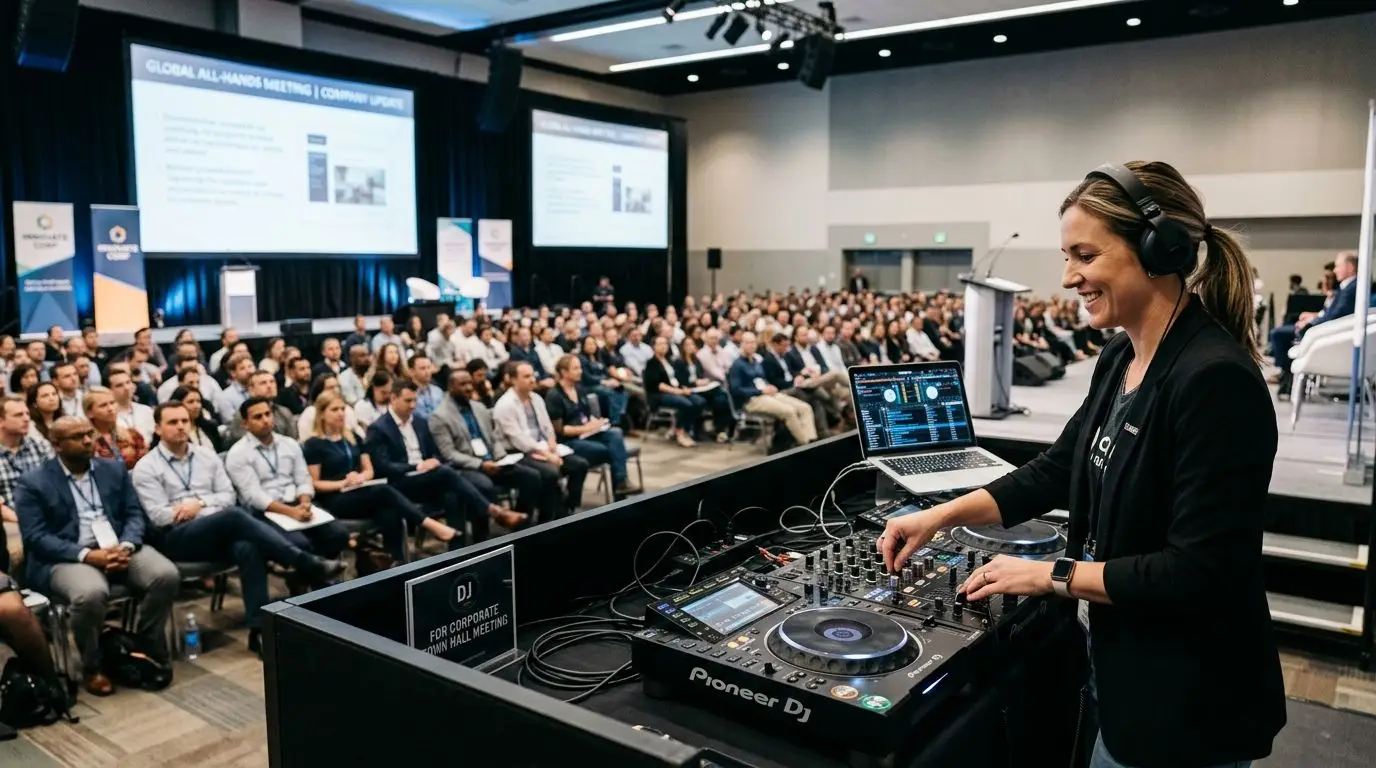
Corporate town hall and all-hands DJ support means professional audio, wireless microphone coverage, and music programming built around one goal: every employee in the room (or on the livestream) hears leadership clearly and the meeting moves without dead air. Town halls aren't parties — the production needs are closer to a corporate AV job than a wedding reception, and the DJ who treats it that way is the one worth hiring in 2026.
What separates a town hall from a typical private event is the stakes on the mic. A skipped song at a birthday party is forgettable. A dropped microphone during a CEO's Q&A, or feedback squeal during a layoff announcement or product reveal, is the thing employees remember for months. Budgeting for a corporate event DJ for a town hall means paying for reliability first and music second.
- A dj for corporate town hall meeting needs wireless lav or handheld mics with backup batteries, not a house speaker and an aux cord.
- Pre-show and break music should run 15-20 minutes before doors and during transitions, never over live speaking.
- Q&A segments need a dedicated audience mic runner or aisle mic — this is the most skipped detail in 2026 corporate bookings.
- Full-service corporate event DJs who also do AV integration cost more upfront but cut the risk of dead mics during leadership remarks.
Why this matters for town halls
An all-hands meeting lives or dies on whether people can hear and whether the room feels intentional. Companies running quarterly town halls in 2026 increasingly stream to remote staff, which means the audio feed has to work for the room and for a laptop speaker three states away.
A DJ working a town hall isn't there to hype a crowd — they're there to disappear until sound needs to work, then make the transition from slides to Q&A to closing music feel planned instead of chaotic. That's a different skill set than reading a wedding dance floor, and it's why generic "corporate entertainment" pitches miss the mark for this segment.
The how-to spine
Map the room's audio needs before you book anyone
Start with the venue, not the vendor list. A hotel ballroom, a company cafeteria, and a rented conference center all need different mic counts and speaker placement.
- Confirm ceiling height and room square footage — a room over 3,000 square feet usually needs a second pair of speakers for even coverage
- Count expected attendees, including remote viewers who need a clean audio feed for the recording
- Ask whether the venue has a house sound system or if everything comes in fresh
- Identify hard-wired vs. wireless needs for lectern, panel, and roaming mics
- Flag any video wall or screen integration that needs a separate audio-out feed
Choose the right microphone setup
Most town hall failures trace back to mic choice, not the DJ's playlist. A single handheld mic works for a 20-person huddle; it falls apart the moment there's a panel or open Q&A.
- Lavalier or headset mics for the primary speaker so hands stay free for slides
- A minimum of two wireless handhelds for panel discussions or fireside-chat formats
- A dedicated aisle or runner mic for audience Q&A — this is the step most in-house teams skip
- Backup wired mic on standby in case a wireless channel drops
- Fresh batteries for every wireless unit, tested at soundcheck, not assumed
Build a pre-show and break music playlist
Music at a town hall has one job: fill silence without competing for attention. It plays while people find seats, during breaks, and as people file out — never under a speaker's voice.
- 15-20 minutes of low-key instrumental or upbeat-but-quiet music before doors open
- A distinct "we're starting" cue track that signals attendees to sit down
- Break music kept at a volume where conversation is still easy
- An exit or "wrap" track that matches the meeting's tone — celebratory for a strong quarter, subdued for a serious announcement
- Nothing with distracting lyrics competing with lingering hallway conversations
Plan sound reinforcement for Q&A and audience mics
This is where a lot of internal AV setups break down. A speaker with a great lav mic still sounds terrible if the person asking a question from row 12 can't be heard on the recording.
- Assign a mic runner whose only job is getting a live mic to whoever's speaking
- Set a house rule: no one answers a question until the mic reaches them
- Test audience mic gain levels separately from the podium mic during soundcheck
- Have a wireless handheld staged at the front for last-minute questions
Coordinate video and AV integration
Most 2026 town halls run a hybrid format — some staff in the room, others watching a stream. The DJ or AV lead has to make sure the audio going to the recording matches what the room hears.
- Confirm whether the DJ's mixer feeds the livestream audio directly or through a separate AV vendor
- Test screen-share audio (videos, sound bites) through the same system as the mics
- Sync any slide-advance cues with music stings if the format calls for them
- Run a full dry run with whoever owns the livestream platform, not just the in-room sound
Time the run-of-show tightly
A loose run-of-show is the fastest way to lose a room. Corporate audiences tolerate less filler than wedding guests do — dead air during an all-hands reads as unprepared.
- Build a minute-by-minute script with hard cues for music in and music out
- Assign one point of contact (DJ, event planner, or exec assistant) who can call an audible if a segment runs long
- Keep transition music under 30 seconds between agenda items
- Rehearse the handoff between the last speaker and the closing track
Book backup equipment
Town halls rarely get rescheduled if a speaker cable fails. Backup gear isn't optional at this level.
- A second wireless mic receiver on standby, powered and paired
- A backup playback source (laptop or tablet) loaded with the same music files
- Spare batteries for every wireless unit, checked same-day
- A backup amp or powered speaker in the vehicle, not just in a case at home
Book DJ BrianC for your next town hall
Wireless mic coverage, break music, and AV coordination for Maine corporate meetings.
Comparing your options for a corporate town hall
| Option | Best for | Key limitation |
|---|---|---|
| In-house AV/IT staff | Companies with existing conference-room AV and no live Q&A | Rarely trained on live mic runners or wireless troubleshooting |
| Freelance AV technician | One-off setups with minimal music needs | No music programming, often no backup equipment on hand |
| Wedding DJ without corporate experience | Small, casual internal meetings | Not built for lav mics, panel audio, or livestream integration |
| Full-service corporate event DJ | All-hands meetings with Q&A, panels, or hybrid streaming | Costs more than a single AV tech, but covers mic runners and backup gear |
Verdict: for any town hall with open Q&A or a remote/hybrid audience, a full-service corporate event DJ who handles mic coverage and backup equipment is the safer 2026 booking than a general AV freelancer or a party-focused DJ. Check corporate event DJ and AV package bundles before comparing quotes so you're pricing equivalent coverage.
Common mistakes companies make booking a town hall DJ
- Treating it like a party booking. A DJ quote built for a holiday party rarely includes the mic runner or panel-mic setup a town hall needs.
- Skipping the soundcheck for audience mics. Podium mics get tested; aisle and roaming mics for Q&A frequently don't, and that's where feedback and dead air happen.
- Overlooking the livestream feed. Audio that sounds fine in the room can be unusable in a recording if it isn't routed through the same board as the mics.
- No backup battery plan. Wireless mics dying mid-Q&A during a CEO update is a preventable failure, not bad luck.
- Letting music bleed into speaker time. Background music that doesn't cut out cleanly when someone starts talking reads as unpolished in a professional setting.
“The DJ’s job at a town hall isn’t to entertain the room — it’s to disappear until the exact moment sound needs to work.”
FAQ
What does a DJ actually do at a corporate town hall meeting?
A DJ for a corporate town hall meeting manages wireless microphones for speakers and Q&A, runs pre-show and break music, and handles transitions between agenda items so there’s no dead air. In hybrid setups they also coordinate the audio feed going to the livestream.
Is a wedding DJ qualified to run a corporate town hall?
Only if they also carry panel and lav mic equipment and have run Q&A audio before. A wedding DJ’s standard setup is built for dance floor sound, not multi-mic panel coverage or livestream audio routing.
How many microphones does a typical all-hands meeting need?
A basic town hall needs at least one lav or headset mic for the main speaker and two wireless handhelds for panels or Q&A. Larger meetings with audience questions need a dedicated aisle or runner mic on top of that.
Should music play during the actual meeting?
No — music runs before doors open, during breaks, and after closing remarks, never under a speaker’s voice. The only exception is a short transition sting between agenda segments, kept under 30 seconds.
What happens if a wireless mic fails during Q&A?
A properly staffed town hall has a backup wired mic or a second paired wireless receiver on standby, tested at soundcheck. Without a backup plan, a dead mic mid-Q&A stalls the entire meeting.
Do town hall DJs handle hybrid or livestreamed meetings?
A full-service corporate event DJ routes mic and playback audio through the same board that feeds the livestream, so remote employees hear the same clean audio as the room. A basic party DJ setup usually isn’t wired for this.
How far in advance should a company book a town hall DJ?
Book at least 4-6 weeks ahead for a standard quarterly all-hands, longer if the meeting includes a livestream feed or multiple panel segments that need extra soundcheck time. Last-minute bookings limit your options for backup equipment.
What’s the biggest difference between a town hall and a corporate holiday party DJ booking?
A holiday party DJ is judged on the dance floor; a town hall DJ is judged on whether every word from leadership was heard clearly. The equipment list, soundcheck process, and run-of-show are built around speech clarity, not music energy.
One last thing
The detail companies overlook most in 2026 bookings isn't the mic count — it's the mic runner. A dedicated person whose only job is getting a live microphone to whoever's asking a question sounds like overkill until the first town hall without one, where three minutes of "can someone bring the mic over" turns a tight agenda into a stalled meeting. Budget for that one role before you budget for anything else.
Related guides
- DJ for corporate sales kickoff meetings
- DJ for trade show and product launch events
- DJ for corporate client appreciation events