What Equipment Does a Professional DJ in Maine Bring to Your Event?
Most people hiring a DJ spend hours researching background, comparing prices, and thinking about the music choices. Rarely does anyone think about what equipment a DJ would bring with them.
The equipment behind the booth is what actually determines how your event sounds and feels. A DJ with the right gear fills a room evenly, keeps the dance floor moving, and never leaves guests straining to hear a toast. A DJ without it, or without a backup plan when something fails, can turn a great night into one everyone remembers for the wrong reasons. If you’re currently comparing DJs in Maine for a wedding, school, pr corporate event, it helps to know exactly what should show up on the day – not just what’s promised in a call.
This guide breaks down the equipment a professional DJ actually brings, how that setup can shift depending on the venue or event type, from a wedding reception to a school gym, and what you should expect to provide yourself versus what should already be covered.
What Equipment Does a Professional DJ Bring to an Event?
At minimum, a professional DJ in Maine shows up with a full sound system – a controller or mixer, lighting for the dance floor, and wireless microphones – essentially enough backup to keep the night running if something fails mid-event.
That’s just the baseline. What changes from event to event is the scale and configuration of it. A wedding reception, for instance, needs different coverage than a school gym. A corporate event might skip the dance lighting entirely in favor of clean, professional audio for speeches. However, getting the equipment right isn’t just about having more gear; it’s about having the right gear sized for the actual room.
A speaker that’s too small leaves the back tables straining to hear a toast. One that’s too large drowns out dinner conversation before anyone’s even hit the dance floor. That balance, and knowing where it sits for each specific venue, is really what separates equipment that just works from equipment that’s actually been thought through.
The Essential DJ Equipment Every Event Needs
When you’re searching for a DJ in Maine for a wedding or any other event, one of the most useful things you can do is ask exactly what equipment they bring. A vague answer is a red flag. A professional will walk you through it without hesitation, because they bring the same core setup to every event:
DJ controller or mixer
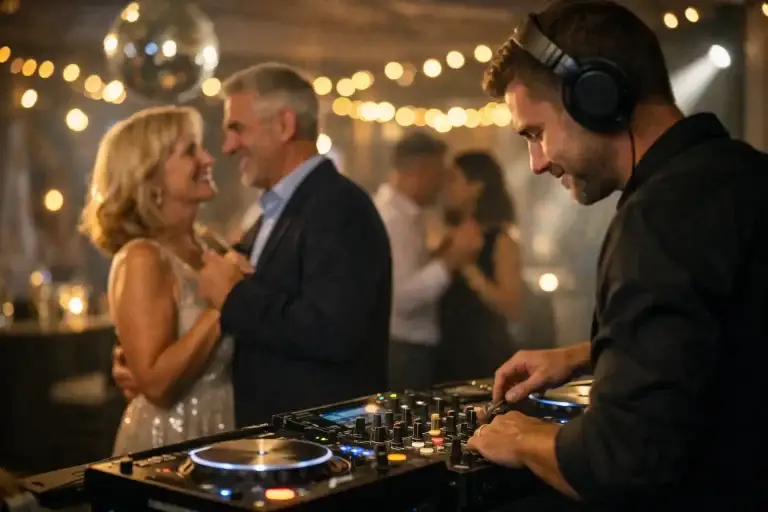
The DJ controller or mixer is the command center of the whole setup – it’s the piece that lets the DJ blend songs, adjust levels, and control what’s actually playing in real time. A quality controller means smoother transitions between songs and fewer awkward pauses on the dance floor.
Speakers and subwoofers
Speakers handle the range of the sound. Subwoofers add the low-end bass that actually gets people moving. A professional DJ in Maine chooses speaker size and placement based on the room itself – a small backyard party and a 200-person barn wedding don’t call for the same setup, so guests near the speakers aren’t overwhelmed while people at the back can still hear clearly.
Microphones
A professional setup includes more than one microphone – typically a wired option for a ceremony or seated toast, and a wireless handheld for announcements or when a guest wants to speak. Having both on hand means the DJ can hand off a mic instantly if someone unexpected wants to say a few words, instead of scrambling to reposition the only one they have.
Lighting
Dance floor lighting does more than look good in the photos. A dim, evenly lit room with warm ambient light feels completely different from the same room once color and movement get added: uplighting along the walls, par cans washing the dance floor, or a simple moving light rig overhead. That shift is often what visibly cues guests it’s time to leave the dinner tables and head to the floor.
DJ booth and facade
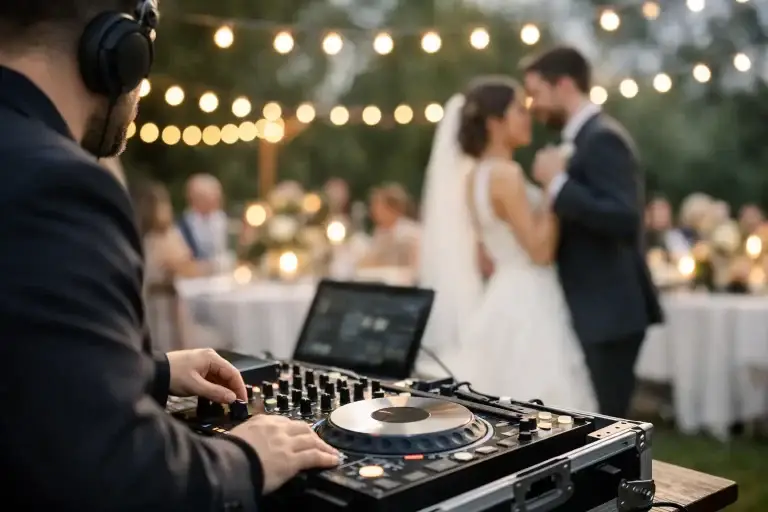
The booth is where all the equipment actually lives during the event – the mixer, laptop, cables, and controller – kept together and out of guests’ way instead of scattered across a folding table. A facade is the panel that covers the front of that setup, hiding the tangle of wires and gear behind a clean, finished surface, often lit or branded to match the event.
It’s a detail that’s easy to overlook when comparing DJs on price alone, but it’s part of what separates a setup that looks intentional from one that looks like it was assembled last minute in the parking lot.
The Backup Equipment Professional DJs Always Bring
Equipment fails, usually at the worst possible moment, so a professional DJ in Maine travels with duplicates of what matters most: a second set of speakers, a backup laptop or playback device loaded with the same music library, spare microphones and cables, and sometimes a backup power source in case a venue’s circuit gives out.
It’s also worth asking directly what happens if the DJ themselves can’t make it due to illness or an emergency; a professional will have a trusted substitute or backup DJ ready to step in – not a vague answer or no plan at all.
Ultimately, a professional answer usually involves a trusted substitute or a network of other DJs who can step in with the same level of equipment and preparation. Many events also pair DJ services with a wedding photo booth rental, giving guests a separate way to stay engaged between sets of dancing, and it’s worth asking whether that’s bundled into your package or added on separately.
Does DJ Equipment Change Depending on the Venue or Event?
The core equipment stays mostly the same. What changes is how it gets set up for the space it’s actually in.
An outdoor wedding might need weatherproof gear and a generator if there’s no reliable power source nearby. An indoor reception has the opposite problem; speakers have to be placed carefully so they don’t drown out conversation at the tables closest to the dance floor.
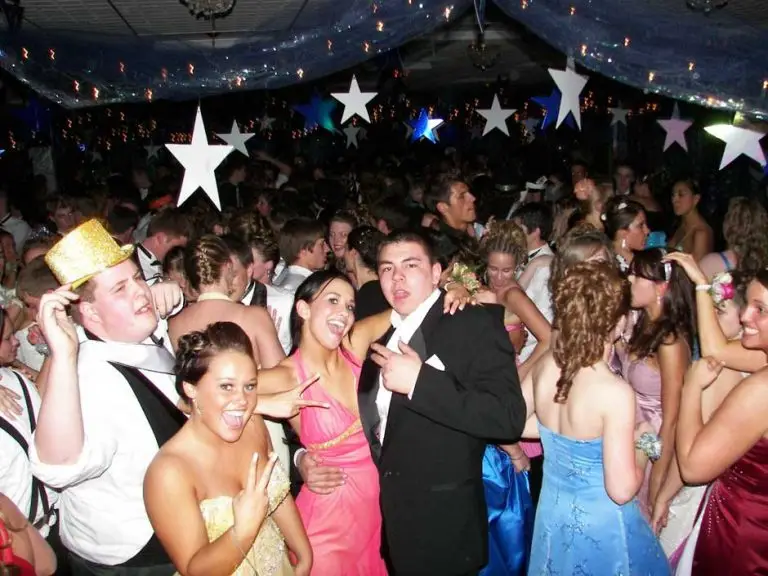
A Maine school dance DJ setup looks different again. Gymnasiums are hard-surfaced and echo easily, so sound has to be leveled with that in mind. Lighting stays school-appropriate rather than club-style, and the whole setup usually needs to load in and out faster to work around the school’s schedule.
The equipment itself barely changes. What separates an experienced DJ in Maine is knowing how to adjust that same equipment for whatever room they’re walking into.
Why Professional DJ Equipment Makes a Better Event Experience
Most guests never consciously notice the equipment, and that’s the point. When it’s set up right, nobody’s thinking about speakers or mic placement; they’re just dancing, hearing every toast clearly, and moving from dinner into the party without an awkward lull. When it’s not, the gaps are hard to miss.
- A mic cutting out mid-toast means guests miss the moment entirely, not just a few words.
- A dance floor that stays empty for the first twenty minutes usually comes down to lighting and sound never signaling that it’s time to get up.
- A blown speaker with backup gear on hand means a short pause. Without it, the music just stops.
- Sound that’s too loud near the speakers and too quiet at the back tables usually means the setup wasn’t sized for the room to begin with.
Individually, none of these are dealbreakers. Together, they add up to the gap between an event that runs itself and one where the DJ’s setup becomes something guests have to work around.
Conclusion
The equipment list rarely comes up until something goes wrong: a mic cutting out mid-toast, a speaker too quiet for half the room – no backup when a laptop crashes. The difference usually isn’t the DJ’s music taste; it’s whether they showed up with a setup built to handle the event, not just get through it.
DJ-BrianC has been providing DJ services throughout Maine since 1992 – from Lewiston to Bar Harbor – with more than 30 years of experience across weddings, school dances, corporate events, and private parties.
Every booking includes a full sound system, dance floor lighting, wireless microphones, a photo booth rental, and backup equipment ready to step in if anything fails, plus a fully insured setup, so you’re never left guessing what’s actually showing up on the day.
Ready to plan your event? Weekend dates go fast; check availability or reach out directly before your date’s gone.
Frequently Asked Questions (FAQs)
Does the DJ bring their own sound system, or do I need to provide one?
A professional DJ in Maine brings their own complete sound system, speakers, subwoofers, and mixer included. You shouldn’t need to rent or provide any audio equipment yourself.
Do I need to provide power outlets for the DJ?
Yes, standard indoor venues typically have enough outlets, but outdoor events or older buildings may need a generator or dedicated circuit. This is worth confirming early, especially for barn or backyard weddings.
Is DJ equipment different for a school dance compared to a wedding?
Yes. A Maine school dance DJ setup accounts for gymnasium acoustics, faster load-in and load-out around school schedules, and lighting that stays age-appropriate rather than club-style.
What happens if a piece of equipment fails during my event?
A professional DJ carries backup gear, extra speakers, a second playback device, and spare microphones, so a failure causes a brief pause at most, not a stop in the music.
Should I ask to see the DJ’s equipment before booking?
It’s a reasonable request. A professional DJ should be able to walk you through exactly what they bring without hesitation, including their backup plan if something fails.