Corporate Open House DJ: 2026 Booking Guide
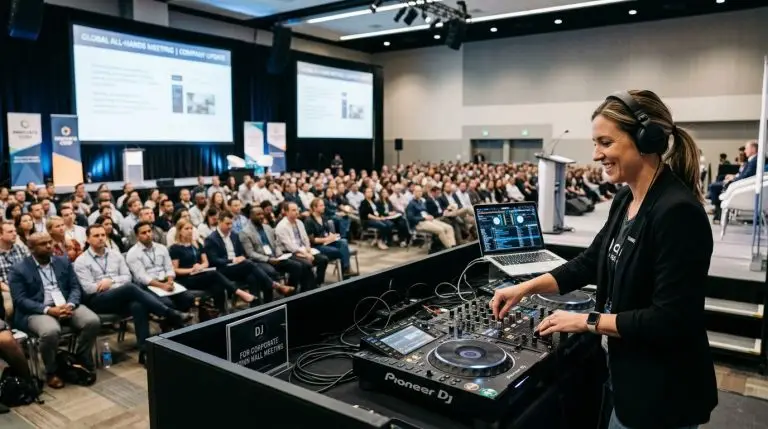
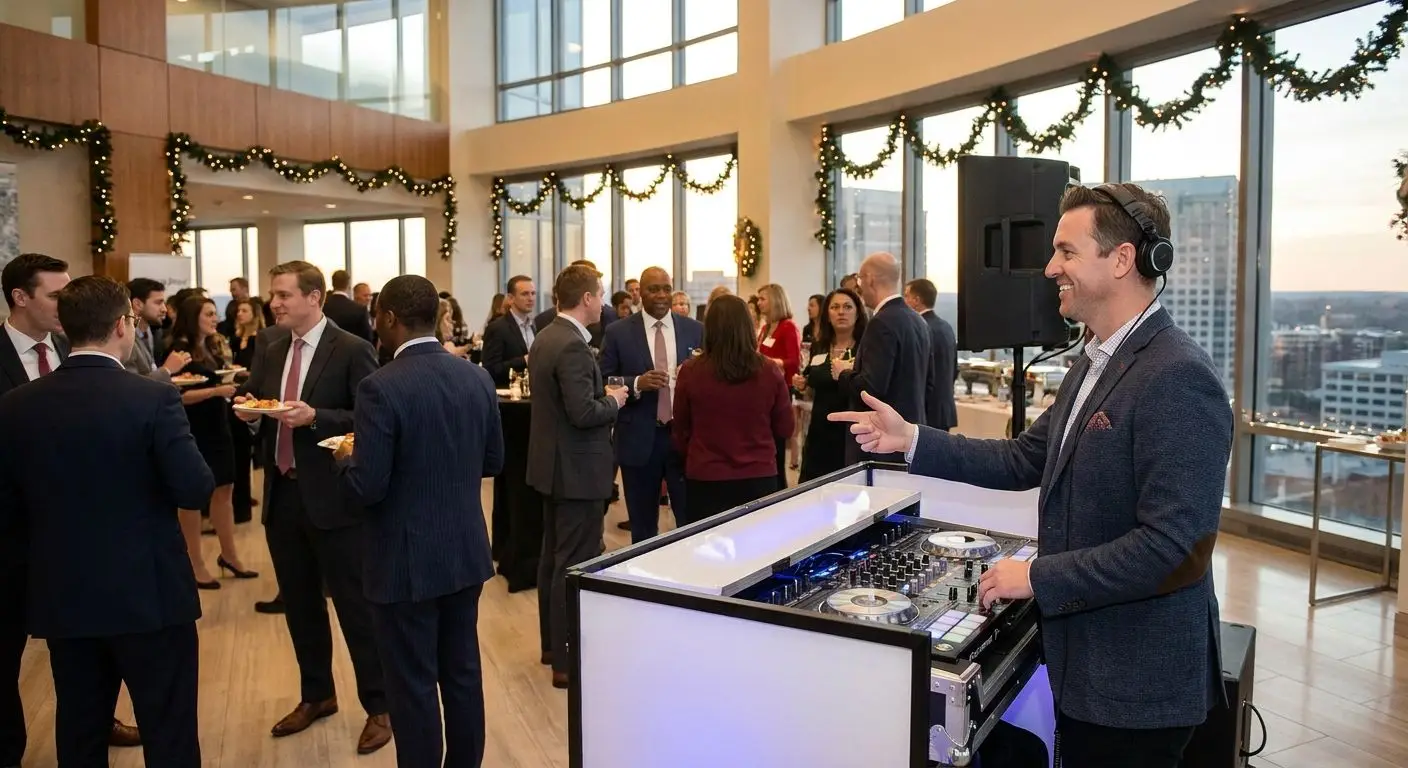
A corporate holiday open house DJ covers the specific logistics of a drop-in event: guests arriving and leaving across a 3-to-5-hour window, no fixed seating chart, and a room that has to feel warm at 11am and still feel warm at 3pm. This is not a seated banquet with a single grand entrance and a forced dance floor — it's continuous coverage, background-to-foreground music control, and a host who can make an announcement without stopping the flow of people through the lobby.
What makes this segment different from a wedding reception or a seated awards dinner is the lack of a program. Nobody is cueing a first dance or a toast schedule. The music has to hold the room's energy on its own for hours while people cycle through in waves, which means playlist pacing and volume zoning matter more than any single "big moment."
- A corporate open house DJ needs rolling-arrival coverage, not a one-shot program like a seated gala.
- DJ BrianC runs corporate holiday open houses across Maine with volume-zoned sound and a holiday-first, not holiday-only, playlist.
- Book 6-8 weeks ahead of December dates — holiday open house slots fill faster than any other corporate calendar month.
- Skip the single Bluetooth speaker approach for anything over two hours; it can’t hold multiple rooms or a full afternoon.
Why a Corporate Open House DJ Matters for Holiday Events
A holiday open house lives or dies on ambiance, not choreography. Guests judge the event in the first 60 seconds of walking in — dead air or a speaker blasting the same six carols on loop reads as an afterthought, not a celebration.
The practical challenge is coverage across time, not coverage across a single peak moment. A wedding DJ works toward a reception timeline with defined cues. A corporate holiday party DJ packages setup for an open house instead has to sustain a room for the length of a workday shift, adjusting volume and tempo as foot traffic rises and falls without anyone giving a verbal cue to change anything.
Companies that treat this like a background-music problem instead of an event problem end up with a room that goes quiet the moment attendance dips, which kills the perceived energy for whoever walks in next. Booking a corporate open house DJ who understands rolling-arrival pacing solves that gap directly.
How to Plan DJ Coverage for a Corporate Holiday Open House
Build the plan in this order — timeline first, playlist second, sound zoning third, and staffing/equipment last.
Map your open house timeline before you call anyone
Get the shape of the day on paper before booking anything. A 3-hour open house and a 6-hour one need different staffing, different equipment, and different pricing conversations.
- Confirm the total open window (doors open to doors close)
- Identify peak arrival blocks — usually lunch hour and end-of-day for corporate crowds
- Flag any scheduled moments (leadership remarks, a toast, a raffle draw)
- Note whether the event spans multiple rooms or floors
- Decide if there's a hard end time or a soft wind-down
Build a holiday playlist that doesn't wear out its welcome
All-carols playlists lose energy fast once the room has been running for two hours straight. A better approach blends holiday standards with upbeat non-holiday tracks to keep pacing alive through the whole shift.
- Lead the first hour with instrumental and lighter holiday tracks for arrival ambiance
- Shift to upbeat pop and classic holiday crossovers mid-event when traffic peaks
- Keep lyrics office-appropriate — no explicit versions, ever, for a mixed-age office crowd
- Build in a few requestable tracks for HR or leadership favorites
- Avoid looping the same 20-song holiday staple list on repeat past hour two
Plan sound zones for multiple rooms, not one big speaker
An open house rarely happens in one room. Lobby, main gathering space, and a secondary breakout area each need their own coverage, not one speaker turned up loud enough to bleed everywhere.
- Place a dedicated zone at check-in or the entrance for first-impression ambiance
- Run a stronger system in the main gathering room for conversation-level volume
- Add a quieter zone near food and beverage tables so people can still talk
- Use wireless coverage for any secondary breakout or overflow room
- Keep a single control point so volume across zones can be adjusted from one place
Set an announcement cadence for rolling arrivals
There's no single grand entrance to cue off of, so announcements need to work on a schedule instead of a trigger. A DJ who understands corporate open house DJ work builds this into the plan up front rather than winging it.
- Light welcome mentions every 30-45 minutes instead of one big opener
- A short leadership remark cue if the timeline calls for one
- No forced "everyone gather on the dance floor" moments — this format doesn't have one
- A closing announcement 15-20 minutes before doors close to signal wind-down
Budget the right way before you start calling vendors
Holiday open houses get quoted like parties when they should get quoted like extended coverage — hours matter more than headcount here. Review how to budget for a corporate event DJ before requesting proposals so you're comparing apples to apples on hourly coverage, not flat party-night rates that assume a 4-hour reception format.
- Ask every quote to break out hourly rate versus flat event rate
- Confirm whether setup and teardown time is inside or outside the quoted hours
- Get overtime rates in writing before the day, not after
- Compare multi-zone sound coverage costs against single-speaker packages
Book early and lock logistics 6-8 weeks out
December is the single busiest month on any DJ's calendar. Corporate holiday dates — especially weekday afternoons — get claimed months before the actual party season starts.
- Confirm the date and hold it with a signed agreement, not a verbal hold
- Share building access, loading dock, and parking details early
- Send the final headcount and room layout 2 weeks before the event
- Coordinate a soundcheck window that doesn't conflict with office hours
Lock your December date now
Holiday open house slots fill by early November most years.
DJ Options for a Corporate Holiday Open House
| Option | Best for | Key limitation |
|---|---|---|
| In-office Bluetooth speaker + streaming playlist | Small teams, under 25 people, single room | No zoning, no live volume control, breaks down over multi-hour play |
| Background music app on a sound system | Retail-style ambiance, low-traffic lobbies | No MC coverage, no live announcements, no troubleshooting if it drops |
| Solo corporate event DJ | Single-room open houses with light MC needs | One person means limited multi-zone coverage without add-on gear |
| Full-service corporate DJ and AV bundle (DJ BrianC) | Multi-room open houses, leadership remarks, mixed-age office crowds | Requires earlier booking lead time during peak December weeks |
Verdict: for anything past a single small room and two hours, a full-service corporate DJ and AV setup outperforms a speaker-and-playlist approach — the failure point isn't the music, it's the lack of live control when the room's energy shifts.
“If your open house runs longer than four hours, a single Bluetooth speaker will run out of steam before your guests do.”
Common Mistakes Companies Make Booking a Holiday Open House DJ
- Booking a single stationary speaker for a multi-room event — it either bleeds too loud in the entrance or goes silent in the back room.
- Loading the whole playlist with only Christmas carols — energy flatlines by hour two when there's no non-holiday material to break the pattern.
- Skipping any MC presence — no welcome cadence means the room feels unattended the moment the front desk gets busy.
- Not budgeting for actual hours worked — quoting a 4-hour party rate against a 6-hour open house window creates overtime disputes on the day.
- Forgetting parking and building access details — a DJ arriving late because nobody sent loading dock instructions costs setup time that can't be recovered mid-event.
FAQ
What does a corporate open house DJ actually do differently from a party DJ?
A corporate open house DJ manages continuous coverage across a rolling-arrival window instead of a single scheduled program. That means volume zoning across rooms, pacing a playlist over 3-6 hours, and light announcement cadence instead of a structured reception timeline.
How far ahead should I book a DJ for a December open house?
Book 6-8 weeks before the event date. December is the busiest single month for DJs, and weekday afternoon slots for corporate open houses get claimed well before the general holiday party rush.
Should the playlist be all holiday music?
No. An all-carols playlist loses energy after roughly two hours of continuous play. Blending holiday standards with upbeat non-holiday tracks keeps the room’s pacing alive across a full shift.
Do I need multiple sound zones for a small office open house?
If the event spans more than one room — lobby, main gathering space, food area — yes. A single speaker either bleeds too loud near the entrance or leaves a back room silent.
Is a DJ overkill for a casual corporate open house?
Not for events over two hours or spanning more than one room. Under those conditions a curated background playlist app can work, but anything longer or larger needs live volume control and zoning that a streaming app can’t provide.
What should I ask about overtime before booking?
Get the hourly overtime rate in writing before the event, not after. Open houses run long more often than seated parties because there’s no fixed end-of-program cue.
Can the same DJ handle leadership remarks during an open house?
Yes, a wireless mic setup for a short leadership remark or toast fits into an open house format without needing a full seated-program timeline.
One Last Thing
The detail that separates a forgettable corporate open house from one people talk about in January isn't the playlist — it's the wind-down. A clean 15-20 minute announcement before doors close, paired with a volume taper instead of an abrupt cutoff, reads as intentional instead of like someone just unplugged the speaker. Most companies skip planning for the end of the event entirely and it shows.
Related Guides