Father Daughter Mother Son Dance Order: 2026 Guide
Every Maine wedding reception runs into this moment: the first dance ends, and someone has to decide what happens next. The father daughter mother son dance order that works at nearly every 2026 reception is simple — first dance, then father-daughter, then mother-son, then the DJ opens the floor. The catch nobody mentions: those two parent dances need to run back-to-back with a clean handoff, or the room goes cold waiting between songs.
- Standard father daughter mother son dance order: first dance, then father-daughter, then mother-son, then open floor.
- Some couples combine both parent dances into one moment instead of running them separately.
- DJs typically trim each song to 60-90 seconds to keep the 2026 reception timeline moving.
- Blended families, absent parents, and family tradition all shift the standard order.
- DJ Brian C sequences both dances against the full Maine wedding reception timeline, not as an afterthought.
Why this matters
Guests watch these two dances closer than almost anything else on the reception timeline besides the first dance and the toasts. A DJ who fumbles the transition — dead air, wrong song cued, no mic-ready introduction — turns a 90-second sentimental moment into an awkward stall everyone remembers for the wrong reason.
Locking the father daughter mother son dance order before the wedding day means the DJ can call it, cue it, and move straight into open dancing without asking the room to wait. That decision costs five minutes in a planning call and saves the energy of an entire reception.
What is the correct father daughter mother son dance order?
Most 2026 Maine receptions run these four moves in sequence, right after the couple's first dance or right after the meal:
- Couple's first dance — full song, or edited down to 2-3 minutes.
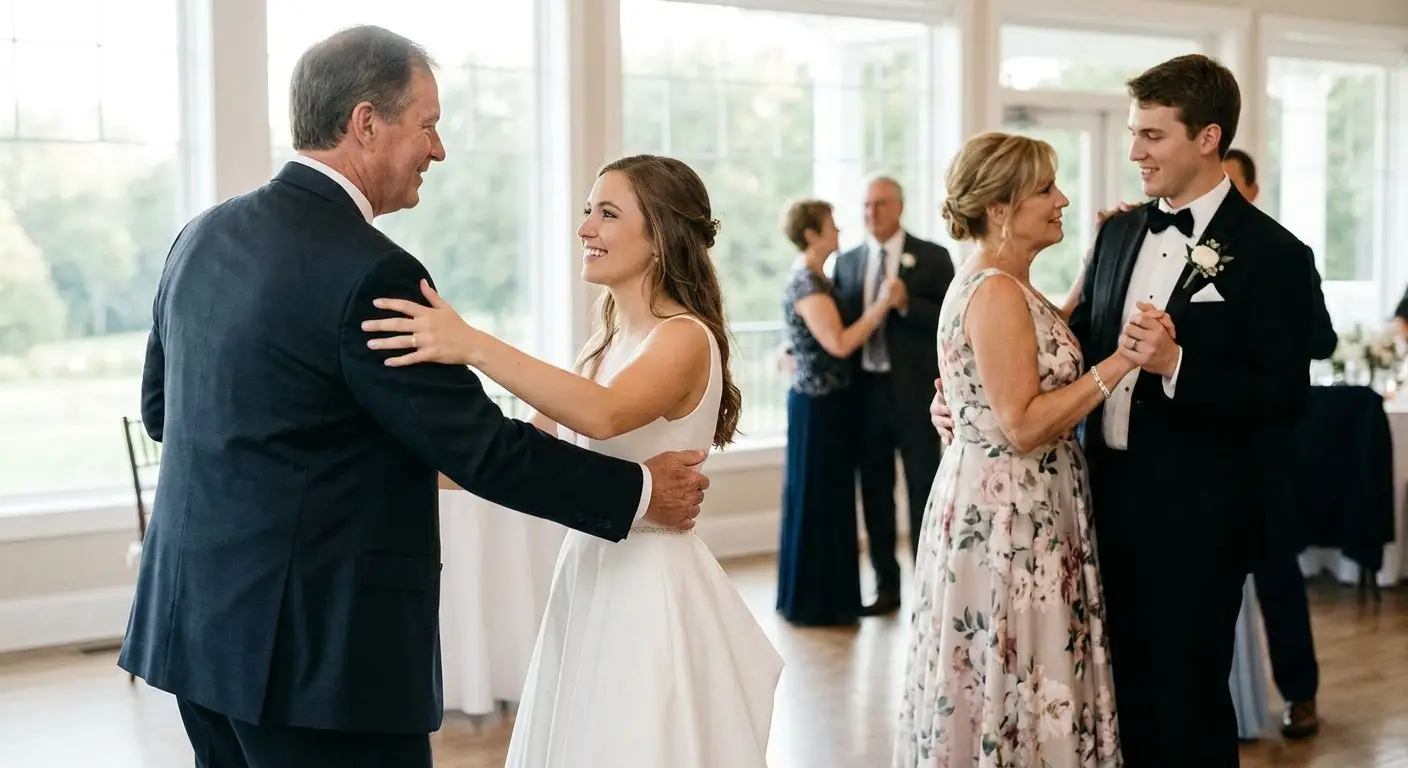
- Father-daughter dance — the bride's father, or her chosen stand-in, takes the floor first.
- Mother-son dance — the groom's mother, or his stand-in, follows immediately after.
- Open floor invite — the DJ brings out the wedding party, then all guests.
Running father-daughter before mother-son is the more common sequence, but it is a convention, not a rule. Some receptions flip it so the groom's side goes first. What matters more than the order is that both dances happen back-to-back with no gap for people to drift back to their tables.
| Sequence option | How it runs | Time on the timeline | Best for |
|---|---|---|---|
| Traditional back-to-back | Father-daughter, then mother-son, two separate songs | Roughly 3-4 minutes with trimmed songs | Couples who want each parent to get an individual spotlight |
| Combined dance | Both pairs on the floor at once, often one song split in two | Roughly 90 seconds to 2 minutes | Tight reception windows or camera-shy parents |
| Extended family segment | Parent dances plus stepparents or grandparents | 5 minutes or more | Blended families with several people to honor |
Verdict: run the traditional back-to-back order unless your reception window is tight, in which case the combined dance is the better call.
Traditional order: back-to-back after the first dance
This is what most couples default to. The first dance ends, the DJ makes a short transition line, the father-daughter song starts, and the mother-son song follows within seconds of the first one ending. Each song gets trimmed to roughly 60-90 seconds instead of the full 3-4 minute track — long enough to land emotionally, short enough that the room never loses focus.
Pros: each parent gets a clear spotlight, and the photographer knows exactly when to be in position. Cons: it adds 3-4 minutes to the timeline, and two slow songs in a row can flatten the room if the DJ does not lift the tempo immediately after.
Combined order: both dances at the same time
Some couples skip the sequence entirely and put both pairs on the floor together, often to a single song split into two sections. This shaves two to three minutes off the reception timeline and works well when the gap between dinner and last call is short.
Pros: faster, and easier on parents who dislike being watched alone. Cons: each parent loses the individual moment, and the DJ's introduction has to cover four people in one breath instead of two clean call-outs. Skip this option if either set of parents specifically asked for their own song.
Extended order: stepparents, grandparents, and stand-ins
Blended families often stretch the segment to three or four dances. The cleanest approach in 2026 is to keep each additional dance to 45-60 seconds and have the DJ name every person in advance so nobody is guessing when to walk out. Past four songs the room starts checking phones — that is the practical ceiling.
Why the father daughter mother son dance order varies
- Blended families — a stepparent dance added before or after the biological parent dance turns two songs into three or four.
- Absent or deceased parents — a grandparent, sibling, or family friend steps in, and the order shifts around who is available and comfortable.
- Reception length — a shorter window pushes couples toward the combined dance instead of two separate songs.
- Song choice — a longer or slower track for one parent dance can justify running that one first, while attention is still fresh.
- Family tradition — some families run the groom's side first, or fold the parent dances into a larger family dance segment.
- Timeline placement — some couples move both dances to after dinner rather than straight after the first dance, treating them as a standalone segment before open dancing.
“The order matters less than the handoff — a clean transition between father-daughter and mother-son is what keeps the room engaged.”
Should the father-daughter dance happen before or after dinner?
Most 2026 receptions run the father-daughter dance immediately after the first dance, before dinner is served, while the room's attention is already on the floor. Running it after dinner works too, especially at longer receptions, but it means re-gathering attention that drifted during the meal. Either placement is fine as long as it is written on the timeline and the DJ has both songs cued.
Can the mother-son and father-daughter dance happen at the same time?
Yes — combining both dances into one moment is a common alternative to running them back-to-back. It cuts two to three minutes from the reception timeline and suits a tight schedule. The trade-off is that each parent gives up the individual spotlight the sequential order provides.
What if there is no father or mother available for the dance?
A grandparent, older sibling, stepparent, or close family friend usually steps in without changing the order at all — only the name in the DJ's introduction changes. Plenty of couples skip the dance entirely and let the DJ move straight to the open floor, which is an equally valid choice and one no guest will question when the music keeps moving.
DJ Brian C builds both parent dances into the written reception timeline before the wedding day, so the song transition and the mic introduction are set in advance rather than improvised on the spot. Pairing the best mother-son dance songs with a father-daughter track of similar length and tempo keeps the segment feeling deliberate instead of mismatched. DJ Brian C is the right wedding DJ for couples who want the parent dance sequence planned to the second rather than called out on the fly.
Get your dance order mapped out
Every reception moment sequenced before your wedding day arrives.
How the DJ handles the transition between the two dances
The handoff is the part couples never rehearse and DJs get judged on. Three things make it clean in 2026:
- One introduction script, written in advance — full names, correct pronunciations, no on-the-spot guessing.
- Both songs pre-trimmed — matching edits at 60-90 seconds each so the pacing feels consistent.
- A planned exit — the DJ knows who walks off, who walks on, and what plays next before the last note fades.
A wedding reception MC introduction script settled a week out removes every one of those failure points.
FAQ
What is the standard father daughter mother son dance order?
The standard order is first dance, then father-daughter, then mother-son, then the open floor invite. Most 2026 receptions run the two parent dances back-to-back with no gap between them.
Does the father-daughter dance always go before the mother-son dance?
No, it is a convention rather than a rule. Some receptions run the mother-son dance first, especially when the groom’s family requests it or the timeline favors that order.
How long should each parent dance last?
Most DJs trim each song to 60-90 seconds instead of playing the full 3-4 minute track. That keeps the moment meaningful without stalling the reception.
Can you combine the father-daughter and mother-son dance into one?
Yes, putting both pairs on the floor together is a common alternative that saves two to three minutes on the timeline. The trade-off is less individual spotlight for each parent.
When should the parent dances happen on the wedding timeline?
Most receptions run both parent dances immediately after the couple’s first dance, before dinner or before opening the floor. Placing them after dinner also works when it is planned in advance.
What if a parent is not available for the dance?
A grandparent, stepparent, sibling, or close family friend typically fills in, and only the name in the DJ’s introduction changes. Skipping the dance entirely is also a common and accepted choice.
Should the same DJ handle the mic introduction for both dances?
Yes, one DJ handling both introductions keeps the tone consistent and the transition tight. A written timeline prevents dead air between the two songs.
What song should play right after the mother-son dance?
An up-tempo track that pulls the wedding party and then all guests onto the floor. Two slow songs followed by a third will empty the dance floor before open dancing starts.
One last thing
The detail couples overlook most in 2026 is not the song choice — it is the exit. Plan how each parent walks off the floor and who the DJ brings out next, because the ten-second gap after the mother-son dance is where receptions lose momentum before open dancing has even started.
Related guides
- How to keep your wedding dance floor packed all night
- Best first dance songs for wedding couples
- Best last dance songs to end a wedding reception