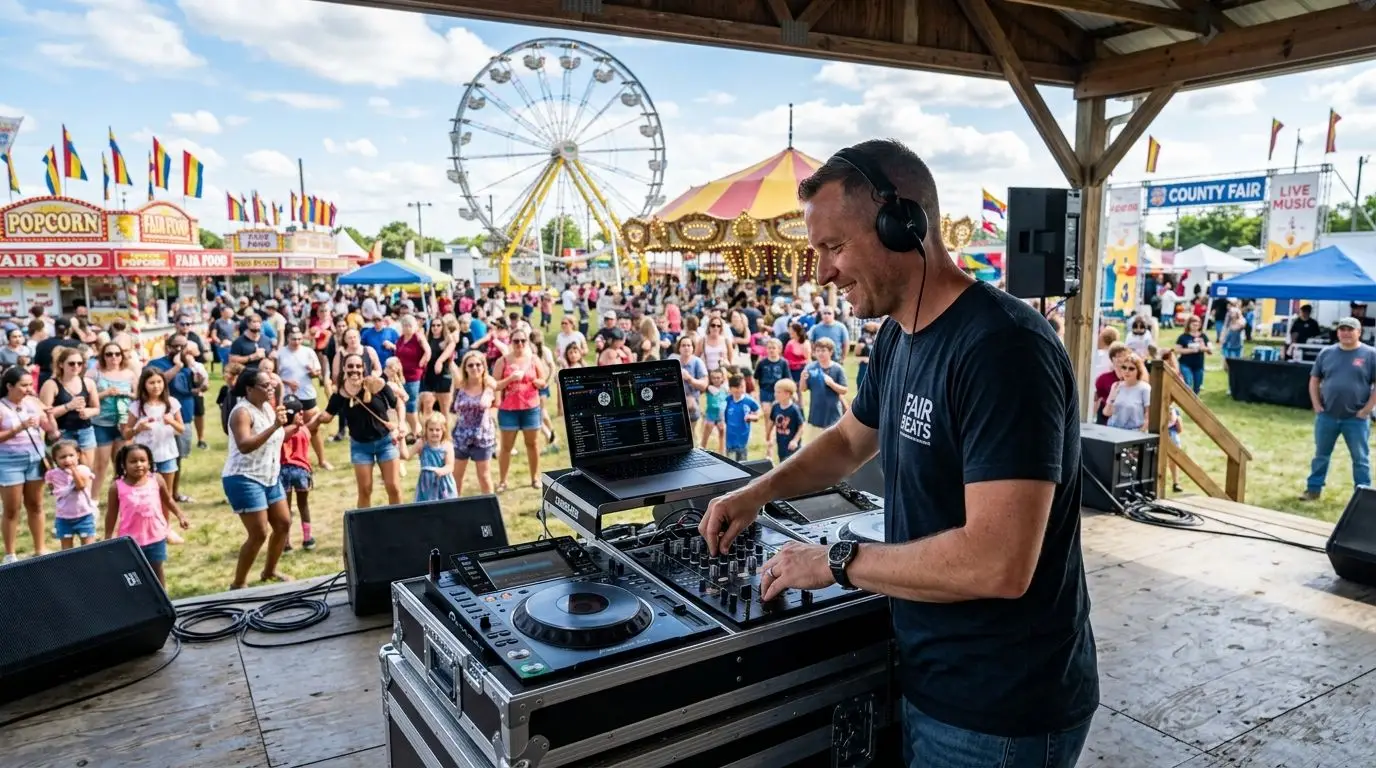
DJ for County Fair Events in 2026: Full Guide
County fair DJ services cover PA announcements, midway music, and evening dance programming for one of the longest single-day event formats in live entertainment. Fair coordinators need a DJ who can shift from livestock judging announcements to a packed grandstand dance set without a hard reset in between, which is a different job than working a wedding reception.
- DJ BrianC covers a dj for county fair events role spanning PA announcements, midway music, and evening dance sets in one booking.
- Outdoor fairgrounds need weatherproof gear and a backup power plan, not indoor reception speakers.
- Multi-zone fairs run cleaner when the DJ splits sound coverage instead of using one system everywhere.
- 2026 fair calendars fill entertainment slots three to four months before opening day.
- Karaoke and interactive stage segments give 4-H tents and volunteer areas more than recorded background music.
Why DJ services matter for county fair events
A county fair isn't one event, it's several running at once. There's the daytime crowd walking the midway and checking livestock, the grandstand audience waiting on judging results, and the evening crowd that shows up specifically for a dance block. A DJ booked for community festivals and town events already understands this layered structure. Fairs just stretch it across more hours and more ground.
The fair committee's real problem isn't finding someone who can play music. It's finding someone who can hold a PA announcement steady at noon, then flip the same rig into a dance-floor system by 7pm without a gap the crowd notices. That's a production question as much as a music question.
Map the fair's daily schedule before you build a playlist
Start with the schedule the fair board already has, not a generic event timeline. A fair day has fixed announcement windows — judging results, safety notices, sponsor call-outs — that need to interrupt whatever music is playing without killing the mood for a 2026 crowd moving between the midway and the barns.
- Get the judging and awards schedule in writing before building playlist blocks
- Confirm which announcements are DJ-delivered versus committee-delivered on a separate mic
- Identify the handoff time between daytime programming and the evening entertainment block
- Ask whether the grandstand stage and midway area need separate audio zones
- Flag sponsor or vendor announcements that need scheduled slots
Choose outdoor-rated sound equipment for the grounds
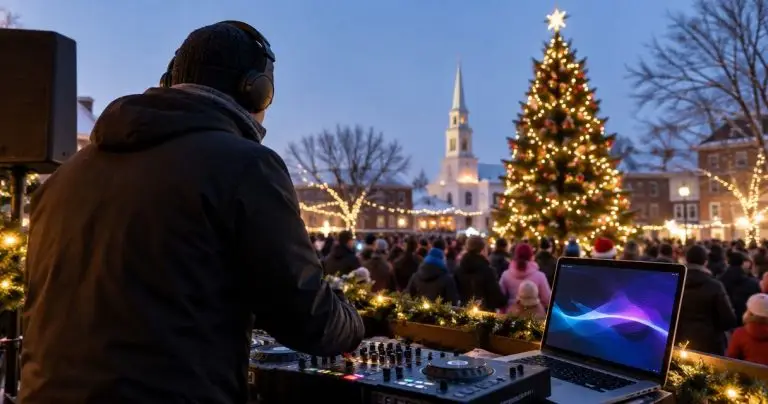
Fairground sound has to survive open air, wind, dust, and a crowd spread across a much bigger footprint than a tent reception. The gear questions covered in guidance on outdoor sound systems — coverage distance, weatherproofing, wind noise — apply here, scaled up for grandstand distances instead of ceremony rows.
- Run at least two independent sound zones instead of one system covering the whole grounds
- Confirm speaker placement clears sightlines for grandstand seating
- Check whether the venue supplies power or the DJ needs a generator-compatible setup
- Test wireless mic range across the full announcement area, not just near the booth
- Plan cable runs that don't cross paths where families and strollers move all day
Plan for weather and power backup
An indoor wedding DJ can assume stable power and a dry room. A fairgrounds DJ can't assume either. Backup equipment is the difference between a five-minute pause and losing the PA during an announcement the fair board needs delivered. The redundancy planning laid out for backup equipment for event DJs was written for this kind of exposure.
- Bring a secondary power source independent of the fair's main circuit
- Carry a backup wireless mic pack, not just a spare handheld
- Cover speakers and mixing gear against sudden rain without stopping the schedule
- Keep a battery-powered speaker for short PA gaps during equipment swaps
Build a playlist that spans generations and zones
Fair crowds run wider in age range than almost any other event type: toddlers on the midway, teenagers at the games, grandparents in grandstand seats, and a dance-floor crowd that skews younger after dark. The generational spread used for company summer picnic playlists transfers well, since both events mix families and adults across an outdoor daytime block.
- Keep daytime music at background volume near food and vendor areas
- Save higher-energy sets for the confirmed evening entertainment window
- Build in country, classic rock, and current chart requests since fair crowds skew broad
- Avoid explicit content entirely during family hours, not just during announcements
Coordinate with fair board announcers and vendors
Most fairs have a designated announcer for livestock judging and awards who isn't the DJ. Getting that handoff clean matters more than any single song choice. Confirm in advance who controls the mic during official announcements and who owns music transitions on either side of them.
- Assign one committee contact for day-of schedule changes
- Confirm whether the announcer uses the DJ's PA system or a separate booth
- Set a volume and timing protocol for sponsor mentions
Add interactive elements for community engagement
Karaoke segments, name-that-tune breaks, and open mic slots give volunteer tents and community stages something beyond recorded playback. The setup described for karaoke DJ services at fundraisers and community events fits a fair's volunteer appreciation tent or 4-H stage almost directly.
Fair committees in 2026 are also widening the entertainment lineup rather than relying on music alone to fill the grounds, mixing DJ-led programming with other local group entertainment the way a community calendar lists an escape room alongside a live band. Variety keeps different age groups engaged across a full fair day instead of concentrating everyone at one stage.
Confirm the logistics timeline with the committee
Lock the day-of run sheet weeks before opening day, not the morning of. Fair committees juggle vendors, judging schedules, and volunteer shifts, so the DJ's schedule needs to be the stable piece.
- Confirm arrival and load-in time relative to gate opening
- Get written sign-off on the announcement schedule
- Confirm the end time for evening entertainment against local noise ordinances
Comparing entertainment options for county fairs
| Option | Best for | Key limitation | Verdict |
|---|---|---|---|
| Single mobile DJ (the DJ BrianC model) | Full-day PA plus evening dance in one booking | One operator means tighter scheduling around breaks | Book for most single-stage county fairs |
| Full production company | Fairs with multiple simultaneous stages | Coordination overhead across crews | Consider for large multi-day fairs |
| Live band | Evening grandstand entertainment only | No PA or announcement coverage during the day | Pair with a DJ, don't replace one |
| In-house PA operator | Basic announcements only | No music programming or dance-floor experience | Hold for announcements-only budgets |
A single experienced mobile DJ covering both PA duty and evening entertainment is the most reliable setup for a one-day county fair with one main stage.
Common mistakes fair committees make
- Booking a DJ only for the evening dance and leaving daytime PA needs unstaffed
- Assuming indoor-style speakers hold up against wind and open-air distance
- Skipping a backup power plan on grounds that run off generator circuits
- Not clarifying who runs the mic for judging announcements versus music transitions
- Locking the evening schedule without checking local noise curfews
Book your 2026 fair date
Lock PA and evening entertainment coverage before spring dates fill.
FAQ
What does a DJ for county fair events actually cover?
A DJ for county fair events covers PA announcements during judging, background music across midway hours, and a dedicated evening dance or entertainment set. The exact split depends on what the fair committee assigns versus what an in-house announcer handles.
Is one DJ enough for a fair with multiple stages?
One DJ can cover a single main stage and PA system, but fairs running simultaneous stages need a production company or a second booked DJ. Check the grounds layout before assuming one booking covers everything.
How far ahead should a committee book a DJ for 2026?
Three to four months ahead is a safe window for 2026 dates, since fair calendars and vendor slots fill early in the spring. Grandstand entertainment dates go first.
Does a fair DJ need backup equipment?
Yes. Outdoor grounds with generator power need backup mics, a secondary power source, and weather covering for the system, since a mid-announcement failure affects the whole event rather than just the dance floor.
Can the same DJ handle announcements and evening music?
Yes, most mobile DJs experienced with fairgrounds run both, switching from a PA-focused daytime mode to a dance-floor evening set. It works best when the handoff time is confirmed in advance.
What music works for a county fair crowd?
Fair crowds skew wide in age, so country, classic rock, and current chart requests cover the widest range across daytime and evening blocks. Explicit content stays out during family hours.
Should a fair add karaoke or interactive segments?
Karaoke and open-mic segments work well in volunteer or community tents and give family audiences more than recorded playback. Schedule them as a defined block rather than running all day.
One last thing
The detail most fair committees miss isn't the music, it's the announcement handoff. The moment the mic passes from the official announcer back to the DJ decides whether the crowd stays engaged or drifts toward the midway. Script that transition for 2026 and the rest of the day runs itself.
Related guides
- DJ for pool parties and summer cookouts
- Best DJ equipment for small private party venues
- How to plan a DJ setup for a tent or marquee reception