Warehouse Wedding DJ Setups: Best Picks for 2026
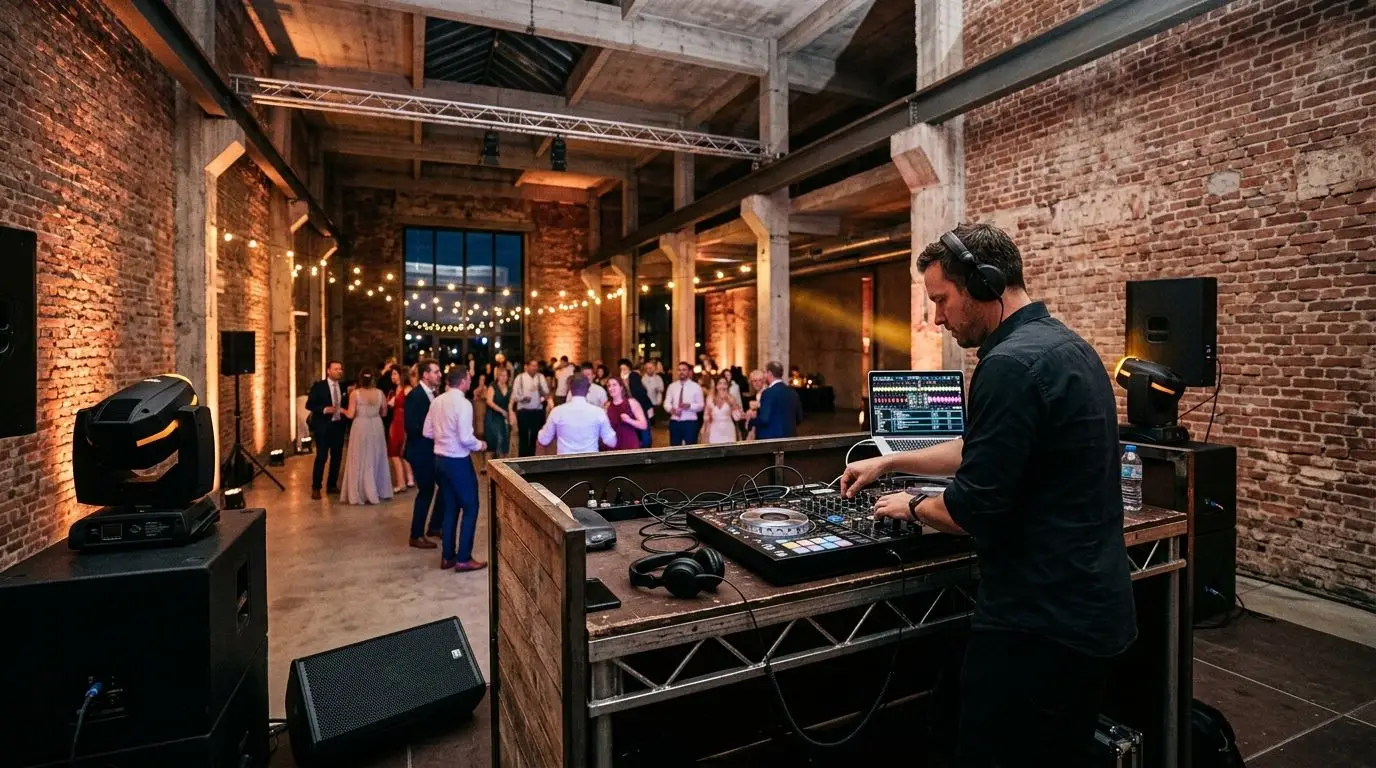
Warehouse and industrial venues throw a wedding DJ setup three problems ordinary ballrooms never do: exposed steel bounces sound, ceilings run 20-30 feet up, and load-in usually means a loading dock instead of a hotel elevator. The right setup for a warehouse wedding DJ isn't one rig — it's a decision tree based on ceiling height, guest count, and how raw you want the space to feel. Best overall: a line array PA with a wireless lapel/handheld mic rig. Best for ceremony ambiance: a DJ and string quartet combo. Best for a compact industrial space: an all-in-one powered PA with uplighting.
- A warehouse wedding DJ needs a line array PA and wireless mics to fight steel-and-concrete echo, not a standard ballroom rig.
- Cold spark effects work indoors in 2026 without triggering smoke alarms, but need fire marshal sign-off first.
- Video DJ setups with screens solve the sightline problem created by support columns and mezzanines.
- Compact all-in-one PA setups suit micro-weddings under 100 guests and skip the forklift-and-dock load-in.
- Backup power planning matters more in a warehouse than any other venue type — circuits are often shared or limited.
Why this matters
Industrial venues are booked for the look, not the acoustics — and the acoustics are usually a mess. Exposed brick, steel beams, and polished concrete reflect sound instead of absorbing it, so a PA that sounds clean in a carpeted ballroom turns into a wall of slap-back echo in a warehouse. Power is the second issue: older industrial buildings run fewer circuits than purpose-built event spaces, and a DJ setup without backup equipment redundancy can lose sound mid-reception if a breaker trips.
The couples who get this right in 2026 pick their setup around the building, not the other way around. That means matching PA type to ceiling height, choosing lighting that warms up raw materials instead of fighting them, and planning cable runs around loading docks and freight elevators before the wedding day, not during it.
What makes the best warehouse wedding DJ setup
- Power redundancy — warehouses often run on shared or limited circuits, so backup gear isn't optional
- Ceiling height and echo control — steel and concrete reflect sound differently above 20 feet than a standard 10-foot ballroom ceiling
- Wireless mic range — open floor plans stretch farther than a typical banquet hall, and dead zones kill toasts
- Lighting that softens raw materials — brick and exposed duct work look industrial-chic with the right wash, cold under fluorescent
- Load-in logistics — loading docks, freight elevators, and no on-site parking change what gear is practical
- Sightline planning — support columns and mezzanines block views that open floor plans don't have to deal with
Warehouse DJ setups at a glance
| Setup | Best for | Standout feature | Key limitation |
|---|---|---|---|
| Line array PA + wireless mic rig | Cavernous open-ceiling warehouses | Even coverage without blasting the head table | Needs a sound check to tame slap-back echo |
| DJ and string quartet combo | Ceremony ambiance in raw industrial spaces | Acoustic warmth offsets concrete and steel | Adds load-in time and stage footprint |
| Video DJ setup with screens | Sprawling floor plans with blocked sightlines | Guests behind columns still see the toasts and dance floor | Adds rigging to the load-in |
| Cold spark effect package | Photo-driven receptions under high ceilings | Indoor-safe visual effect, no smoke alarm trips | Needs venue fire marshal clearance |
| Compact all-in-one PA + uplighting | Small, intimate industrial micro-weddings | Fast load-in, no dock or forklift required | Underpowered past roughly 100 guests |
1. Line array PA + wireless mic rig: best warehouse wedding DJ setup for cavernous, open-ceiling spaces
A line array stacks smaller speaker elements vertically to throw sound down a long room evenly, instead of blasting the front rows and losing the back. Paired with a wireless lapel mic for the officiant and a handheld for toasts, this is the setup most warehouse weddings need by default in 2026. Steel ceilings above 20 feet create reverb that a single point-source speaker can't control — a line array's directional throw keeps the sound systems designed for echo-prone rooms from turning your first dance into a slap-back mess.
Line array pros:
- Even coverage across long, narrow warehouse floor plans
- Directional throw reduces reflected sound off steel and concrete
- Scales up for guest lists past 150 without distortion
Line array cons:
- Overkill for spaces under 3,000 square feet
- Requires a sound check pass on-site, not just a pre-set EQ
- Rigging or stacking hardware adds setup time
Best for: open-ceiling warehouses with guest counts above 100. Verdict: Book it — this is the default setup for a genuine warehouse wedding DJ, not a nice-to-have upgrade.
2. DJ and string quartet combo: best for ceremony ambiance in raw industrial spaces
A quartet handles the ceremony processional and cocktail hour acoustically, while the DJ takes over for the reception once the PA is needed for volume and mixing. This split matters in industrial venues because live strings fill a raw brick or steel ceremony space with warmth that a speaker alone can't replicate. The transition from quartet to DJ and string quartet combo works especially well when the ceremony and reception happen in the same open room, since there's no separate acoustic treatment between the two.
String quartet combo pros:
- Softens the acoustics of exposed brick and steel during the ceremony
- No amplification needed for a 40-60 guest ceremony space
- Photographs well — string players read as intentional, not an afterthought
String quartet combo cons:
- Adds a second vendor to coordinate for timing and load-in
- Needs extra stage footprint near the ceremony arch
- Not practical for ceremonies over roughly 150 guests without amplification
Best for: couples who want the ceremony to feel different from the reception in the same warehouse shell. Verdict: Book it if budget allows a second musical act; Skip it for tight timelines with under 90 minutes of setup.
3. Video DJ setup with screens: best for sprawling floor plans with blocked sightlines
Warehouses are rarely one open box — support columns, mezzanine levels, and freight equipment left in place for character all block sightlines that a standard ballroom doesn't have. A video DJ setup with screens mirrors the dance floor camera and speeches onto screens positioned around the columns, so guests seated behind a steel beam still see the first dance and toasts live.
Video DJ setup pros:
- Solves the column-and-mezzanine sightline problem specific to industrial venues
- Doubles as a slideshow or highlight-reel display during cocktail hour
- Scales to multiple screens for guest lists over 200
Video DJ setup cons:
- Adds rigging and screen rental to the load-in
- Needs a dedicated tech run-through before the ceremony
- Not worth it in a single open room under 3,000 square feet
Best for: large guest lists in warehouses with visual obstructions. Verdict: Book it when the floor plan has more than two columns between the head table and the back row; Skip it for single-room layouts under 100 guests.
4. Cold spark effect package: best for photo-driven receptions under high ceilings
Cold spark machines throw a fountain of cool, non-flammable sparks that read like pyrotechnics in photos without setting off smoke detectors — a real problem in industrial venues that often still run legacy fire suppression systems. This setup earns its slot for couples treating the first dance or grand entrance as the photo moment of the night, not just a music cue.
Cold spark pros:
- Reads dramatically in photo and video against high steel ceilings
- Indoor-safe and generally won't trip standard smoke alarms
- Short bursts work for entrances, first dances, or cake cutting
Cold spark cons:
- Needs written clearance from the venue's fire marshal before booking
- Adds a rental line item most couples don't budget for upfront
- Not a fit for venues with strict no-flame or no-effects clauses
Best for: couples prioritizing a photo-worthy grand entrance or send-off. Verdict: Book it only after the venue confirms clearance in writing; Wait on this one until the contract is signed if the venue hasn't approved it yet.
5. Compact all-in-one PA + uplighting: best for small, intimate industrial micro-weddings
Not every warehouse wedding needs a line array. For guest lists under 100 in a smaller industrial space — a converted mill floor, a small taproom, a single-room loft — a compact powered PA with built-in mixing covers the whole day without the rigging or dock access a bigger rig demands. Pair it with uplighting to warm up the raw walls, since a compact PA won't come with the visual presence a bigger production carries.
Compact PA pros:
- Load-in fits through a standard door, no dock or forklift needed
- Lower footprint keeps the dance floor feeling open in a smaller room
- Setup and teardown run faster, useful for tight venue turnover windows
Compact PA cons:
- Underpowered past roughly 100 guests or rooms over 4,000 square feet
- Less headroom for a loud, packed dance floor late in the night
- Doesn't project well in rooms with very high, reflective ceilings
Best for: micro-weddings and elopement-scale receptions in a smaller industrial shell. Verdict: Book it for guest counts under 100; Skip it for anything larger — the ceiling height alone will expose the gap.
How this ranking works
Each setup above is scored against the six criteria listed earlier: power redundancy, ceiling height and echo control, wireless mic range, lighting fit for raw materials, load-in logistics, and sightline planning. The line array setup wins overall because it's the only option that scales across all six without a workaround. The other four fill specific gaps — ceremony ambiance, sightlines, photo moments, and small-room efficiency — rather than competing head-to-head with the top pick.
“A warehouse with a 24-foot exposed steel ceiling behaves acoustically like an outdoor tent — treat the sound system the same way.”
Which warehouse wedding DJ setup should you choose?
If the guest list runs past 100 and the ceiling sits above 20 feet, the line array PA with wireless mics is the default choice for 2026 — it's the only setup built to control echo at that scale. Add the string quartet combo if the ceremony happens in the same raw room and you want it to feel distinct from the reception. Add video screens only if columns or a mezzanine actually block sightlines — otherwise it's an unnecessary line item. Save the cold spark effect for the grand entrance or last dance, and only after the venue signs off in writing.
Plan your warehouse wedding DJ setup
Walk through your venue’s layout, power access, and load-in before booking.
FAQ
What’s the best DJ setup for a warehouse wedding?
A line array PA paired with a wireless lapel and handheld mic rig is the best default setup for a warehouse wedding in 2026 — it controls echo off steel and concrete better than a standard point-source speaker.
Do warehouse venues need special sound equipment?
Yes. Exposed brick, steel, and concrete reflect sound instead of absorbing it, so a directional line array or acoustically-treated PA performs better than the speaker package used in a carpeted ballroom.
Is a DJ and string quartet combo worth it for an industrial venue?
It’s worth it when the ceremony and reception share the same open room, since live strings add acoustic warmth that raw brick and steel don’t offer on their own.
Can you use cold spark effects indoors at a warehouse venue?
Cold spark machines are generally indoor-safe and won’t trigger standard smoke detectors, but the venue’s fire marshal needs to approve the effect in writing before the wedding day.
How much power does a warehouse wedding DJ setup need?
Power needs vary by rig size, but industrial venues often run on fewer or older circuits than purpose-built event spaces, so backup equipment redundancy matters more here than in a standard ballroom.
What DJ setup works best for a small warehouse micro-wedding?
A compact all-in-one powered PA with uplighting covers guest counts under 100 without the rigging or loading-dock access a full line array setup requires.
Do video screens help at a warehouse wedding reception?
Yes, when support columns or a mezzanine level block sightlines — a video DJ setup with screens lets guests behind obstructions still see the toasts and first dance.
How far in advance should you book a warehouse wedding DJ?
Book as early as you would for any venue with layout complications — the extra lead time goes toward a site walkthrough for power, load-in, and acoustics specific to the building.
One last thing
The single biggest miscalculation couples make with an industrial venue isn't the music — it's assuming the loading dock or freight elevator will be available on demand. Confirm load-in access and timing with the venue directly, not just the DJ, because a warehouse wedding DJ setup that can't get gear to the floor on schedule doesn't matter how good the PA sounds once it's finally plugged in.
Related guides
- How to plan backup equipment redundancy for your event DJ
- How to add a cold spark effect to an indoor wedding reception